Types of Counseling Approaches: Your Practical Guide


TL;DR:
Choosing the right therapy depends on your specific goals, symptoms, and personal preferences rather than popularity.
Structured approaches like CBT and DBT emphasize active participation and homework, while psychodynamic therapy offers deeper exploration of unconscious patterns.
When anxiety keeps you up at night, trauma replays on a loop, or emotions feel completely out of control, the last thing you need is a confusing menu of therapy options with no guidance on what actually works. The types of counseling approaches available today span everything from structured skill-building programs to deep memory reprocessing. Each one works differently, treats different problems, and suits different people. This guide breaks down the major counseling methods clearly, so you can walk into your first session with a sense of direction rather than dread.
Table of Contents
Key takeaways
Point | Details |
No single approach fits everyone | Match therapy to your specific symptoms, readiness, and personal preferences rather than picking the most popular option. |
CBT has the strongest research base | Over 2,000 randomized trials support CBT for anxiety and depression, making it a reliable first choice. |
EMDR leads in trauma treatment | For PTSD and trauma, EMDR and Trauma-Focused CBT consistently outperform general talk therapy in fewer sessions. |
Integrative therapy is common and effective | Most skilled therapists blend multiple modalities to fit your evolving needs rather than sticking rigidly to one method. |
The therapeutic relationship matters most | Therapist competency and alliance with the client predict outcomes more reliably than any single modality. |
Types of counseling approaches: what to evaluate first
Before you can pick a therapy, you need to know what you are actually looking for. That might sound obvious, but most people walk into the search process backwards. They Google a therapy name they heard about and then try to fit their problem to the solution. Flip that around.
Start with these questions:
What is your main goal? Symptom relief, trauma processing, better relationships, or emotional regulation each point toward different counseling methods.
How structured do you want sessions to be? Some approaches assign homework and follow a clear weekly agenda. Others are open-ended and exploratory. Neither is better. They suit different people.
How severe and urgent are your symptoms? Crisis-level emotional dysregulation calls for a different approach than low-grade chronic anxiety.
What is your therapist trained in? Not every counselor is certified in every modality. Asking directly about their training matters.
How ready are you to engage actively? Therapy requires active practice between sessions. Structured therapies like CBT and DBT depend heavily on homework completion.
Pro Tip: Ask a prospective therapist to describe a typical session and how they would approach your specific concern. Their answer tells you more than any credential on a website.
1. Cognitive Behavioral Therapy (CBT)
CBT is the most researched psychological approach in existence. With over 2,000 randomized controlled trials behind it, it is considered first-line treatment for anxiety, depression, OCD, and phobias. The core premise is straightforward: your thoughts, feelings, and behaviors all influence each other. Change the thought pattern and the emotional and behavioral response shifts too.
Sessions are structured, typically running 12 to 20 weeks. You will work through specific techniques like thought records, behavioral experiments, and exposure exercises. There is homework. If you skip it, progress slows significantly. For OCD specifically, a specialized version called Exposure and Response Prevention (ERP) is considered even more effective than standard CBT protocols.
CBT works best for people who want practical tools and are comfortable with a goal-oriented format. It is less suited for those seeking to explore deep historical patterns or relational dynamics.
2. Dialectical Behavior Therapy (DBT)
DBT was designed for borderline personality disorder but has since proven effective for anyone struggling with intense emotional swings, self-harm urges, or crisis-level distress. DBT runs 6 to 12 months and combines individual therapy with a weekly skills group, making it one of the more intensive counseling methods available.
The four skill modules are mindfulness, distress tolerance, emotion regulation, and interpersonal effectiveness. These are not abstract concepts. You practice them in specific, scripted ways until they become automatic. DBT also includes phone coaching so clients can get real-time support during a crisis between sessions.
This is not a light-touch therapy. It demands genuine commitment. But for people whose emotions derail their daily functioning, nothing else comes close.
3. Acceptance and Commitment Therapy (ACT)
ACT takes a genuinely different angle from CBT. Rather than trying to challenge or fix painful thoughts, ACT helps clients change their relationship to those thoughts through mindfulness and values-based action. The goal is psychological flexibility, not thought correction.
The central idea is that suffering often comes not from painful emotions but from your attempts to fight or escape them. ACT teaches you to observe thoughts without fusing with them and to keep moving toward what matters to you even when distress is present.
It works well for chronic pain, burnout, anxiety, and people who have already tried CBT without lasting results. The sessions feel less clinical than CBT and tend to include metaphors, mindfulness exercises, and exploration of personal values.
4. Eye Movement Desensitization and Reprocessing (EMDR)
EMDR is the gold standard for trauma processing. Along with Trauma-Focused CBT, it is one of the first-line evidence-based treatments for PTSD, recommended by the World Health Organization and major clinical bodies worldwide.
The approach works by targeting the way traumatic memories are stored in the brain. Using bilateral stimulation, typically through guided eye movements, clients process distressing memories in a way that reduces their emotional charge. Many people find that memories lose their grip after just a handful of sessions. You can read more about how this works in practice in Hesketherapy’s deep-dive on the EMDR recovery process.
EMDR does not require you to talk extensively about what happened. For clients who struggle to verbalize trauma, that distinction matters enormously.
5. Psychodynamic therapy
Psychodynamic therapy is the modern descendant of psychoanalysis. It focuses on how unconscious patterns, early relationships, and unresolved emotional conflicts shape your current behavior and emotional life. Sessions are open-ended, exploratory, and relationship-focused.

This approach works best for people dealing with recurring relational problems, persistent feelings of emptiness or low self-worth, or who want deeper self-understanding beyond symptom management. Progress takes longer than structured therapies, often unfolding over months or years. But for certain presentations, the depth it reaches is irreplaceable.
It is not the most structured method. If you prefer a clear agenda and measurable goals, another approach will likely suit you better.
6. Trauma-Focused CBT (TF-CBT)
TF-CBT is a specialized adaptation of standard CBT developed specifically for trauma survivors, including children, adolescents, and adults. It addresses avoidance, trauma-related distortions, and emotional dysregulation in a structured, phased format.
Research shows that TF-CBT and EMDR outperform non-trauma-focused therapies significantly for PTSD symptoms. The structured nature of TF-CBT makes it particularly useful when clients need a clear sense of progression. For an in-depth comparison of how this stacks up against other trauma methods, Hesketherapy’s piece on CBT vs. RTT for trauma is worth reading.
7. Motivational Interviewing (MI)
Motivational Interviewing is not a full therapy system. It is a directive but non-confrontational technique designed to resolve ambivalence about change. It is widely used in substance use treatment but increasingly common in any context where a client is stuck between wanting to change and resisting it.
The therapist uses reflective listening and open questions to draw out the client’s own reasons for change. No lecturing. No persuading. The goal is to help clients hear their own motivation more clearly. MI works beautifully as a standalone technique or as a component within a broader integrative approach.
8. Integrative therapy
Integrative therapy is less a distinct modality and more a clinical philosophy. Rather than applying a single protocol, an integrative therapist draws on multiple evidence-based counseling techniques and adjusts the mix based on what each client needs at each phase of treatment.
Phase-based treatment models are a strong example of integrative thinking in action. A trauma client might start with DBT skills for stabilization, move into EMDR for memory processing, and finish with ACT to consolidate meaning-making and values alignment. This sequencing reduces dropout and improves long-term outcomes for complex cases.
The risk with integrative therapy is inconsistency if the therapist lacks depth in the methods they claim to combine. Ask specifically which modalities your therapist is formally trained in, not just familiar with.
Pro Tip: When interviewing a therapist about their integrative approach, ask which two or three modalities they rely on most. Vague answers like “whatever works” are a warning sign. Specificity signals real training.
Counseling approaches compared at a glance
Approach | Main focus | Best for | Session structure | Homework? |
CBT | Thought and behavior patterns | Anxiety, depression, OCD | Structured, 12-20 sessions | Yes, extensive |
DBT | Emotion regulation and crisis skills | BPD, self-harm, emotional dysregulation | Intensive, 6-12 months | Yes, daily skills |
ACT | Psychological flexibility and values | Burnout, chronic issues, anxiety | Moderate structure | Some |
EMDR | Trauma memory reprocessing | PTSD, trauma, phobias | Flexible, varies | Minimal |
Psychodynamic | Unconscious patterns and relationships | Relational issues, identity | Open-ended, long-term | Rarely |
TF-CBT | Structured trauma processing | PTSD, abuse, trauma | Phased, structured | Yes |
MI | Motivation and ambivalence | Behavior change, addiction | Brief and directive | No |
How to choose the right counseling approach
Choosing a therapy modality does not need to be a high-stakes decision. The right approach depends on symptom type, severity, and how you personally process information. Here is a practical way to narrow it down:
Identify your primary concern. Trauma calls for EMDR or TF-CBT. Anxiety and depression respond strongly to CBT. Emotional dysregulation warrants DBT. Burnout and chronic stress often suit ACT.
Assess your readiness for homework. If you will not complete exercises between sessions, a heavily structured approach will frustrate you. Start with something more exploratory and build toward structure when you are ready.
Check for therapy options available for anxiety by reviewing reputable resources like this anxiety therapy guide to see how different modalities stack up for your specific symptoms.
Ask your therapist directly about their formal training. If they say they use EMDR, ask how many cases they have treated and whether they have completed official certification.
Trust the relationship. Therapy outcomes depend heavily on the quality of the working alliance between therapist and client. If a therapist uses a less popular method but you feel genuinely understood, that combination will outperform the “correct” modality delivered without real connection.
My honest take on picking a therapy approach
I have worked with clients across a wide range of presentations, from expats navigating identity loss and burnout to people carrying trauma that shaped their entire adult lives. What I have learned is that the modality label matters far less than most people think when they first start researching therapy.
What I see consistently is this: clients who read about CBT and decide that is what they want often arrive with a fixed idea that becomes its own obstacle. They want the technique, not the process. Real healing happens when clients stay curious and let the work evolve. In my practice, a session that starts as CBT might shift into something that looks closer to EMDR if a memory surfaces, or might spend twenty minutes in MI territory if ambivalence is blocking progress.
The acronyms are tools, not identities. A good therapist uses them the way a skilled cook uses knives: selectively, precisely, and always in service of what you are actually making. My honest advice is to spend less energy matching yourself to a modality and more energy finding a therapist who is both competent and someone you genuinely trust. Ask hard questions. Show up for the homework. Communicate when something does not feel right.
Therapy is not something that happens to you. It is something you do actively, with support. That shift in mindset makes more difference than any technique.
— Heske
Ready to find your fit? Hesketherapy can help
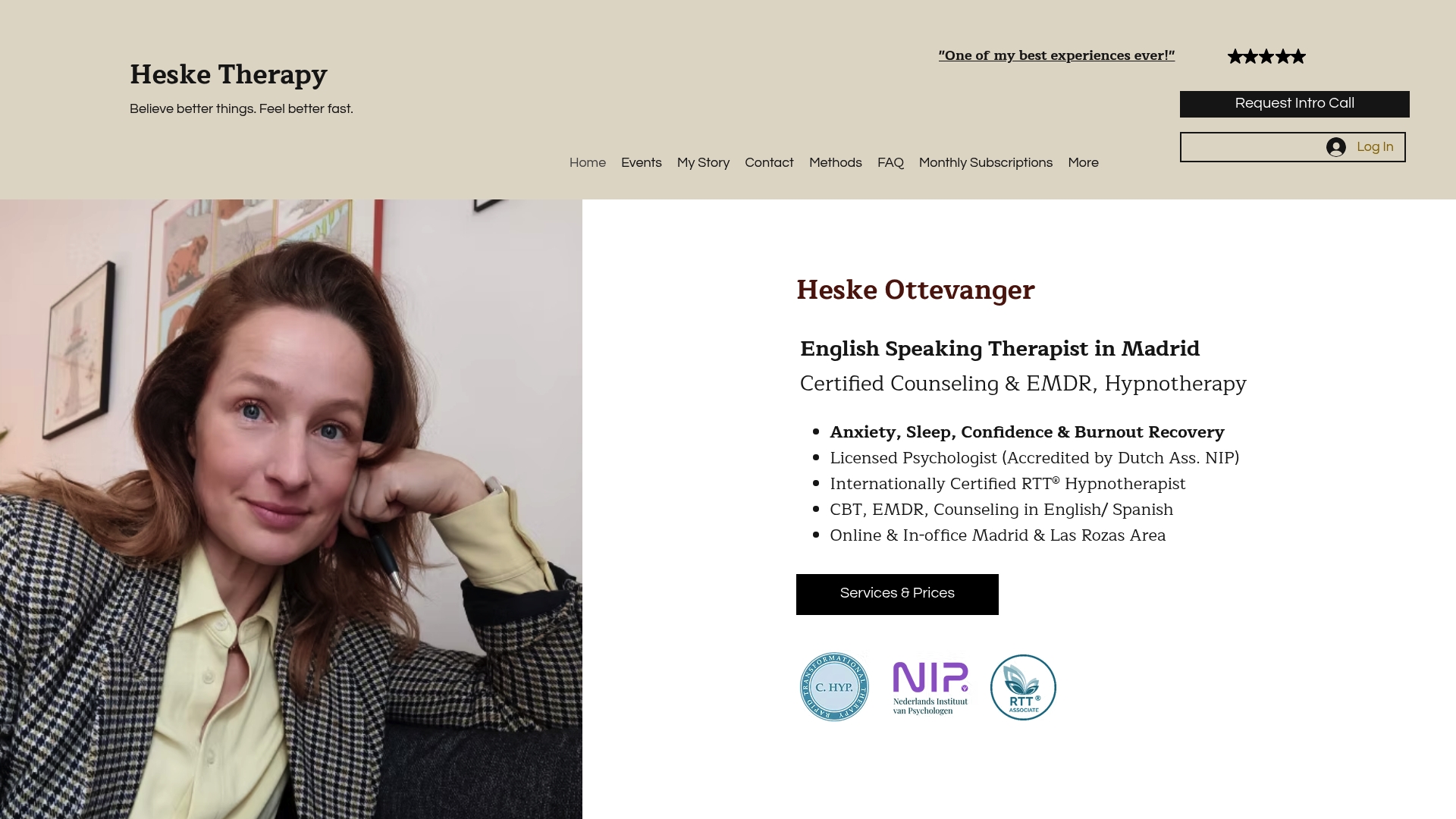
At Hesketherapy, no two treatment plans look the same. Whether you are dealing with anxiety that has followed you across borders, trauma that has never been properly addressed, or burnout that has left you running on empty, the work begins with understanding which combination of approaches will actually move the needle for you. Sessions integrate CBT, EMDR, RTT, and hypnotherapy in formats tailored to where you are right now, available both online and in-person in Madrid. The first step is a free discovery call, with no pressure and no commitment. Book your session and explore which therapeutic approach fits your life. If you want to understand a specific method before committing, the RTT therapy page is a strong place to start.
FAQ
What are the most common types of counseling approaches?
The most widely used approaches include CBT, DBT, ACT, EMDR, and psychodynamic therapy, each targeting different symptoms and suited to different client needs and preferences.
How do I know which counseling approach is right for me?
Start by identifying your main concern, such as trauma, anxiety, or emotional regulation, then find a therapist formally trained in the methods most supported by research for that condition.
Is CBT better than other therapy types?
CBT has the strongest research base with over 2,000 clinical trials, but it is not universally superior. EMDR outperforms CBT for trauma, and ACT or DBT may suit clients with specific emotional profiles better.
What is integrative therapy and how does it work?
Integrative therapy blends multiple counseling methods, often in a phased sequence, so the therapist can adapt techniques to your specific needs and progress rather than following one rigid protocol throughout treatment.
Can therapy work online as effectively as in person?
For most counseling approaches, including CBT, ACT, and DBT, research supports online delivery as comparably effective to in-person sessions when the therapist is qualified and the client is engaged.
Recommended
Comments