Somatic Therapy Explained: Body-Based Relief for Expats


TL;DR:
Somatic therapy addresses psychological distress by working directly with bodily sensations and nervous-system responses, offering expats in Madrid a body-centered approach beyond traditional talk therapy. It involves techniques like sensation tracking, breathwork, grounding, and titration to regulate emotions within the window of tolerance, with models such as SE and Sensorimotor Psychotherapy varying in focus and evidence. Choosing a qualified therapist requires assessing their training, pacing strategies, cultural awareness, and transparency to ensure safe and effective treatment tailored to expats’ unique relocation stress.
Many English-speaking expats in Madrid arrive already exhausted. They’ve talked about their anxiety, their burnout, their trauma in session after session, and yet the tight chest, the restless nights, and the low-grade dread remain. This is where somatic therapy offers something different: it treats psychological distress by working directly with bodily sensations and nervous-system responses, not just with words and thoughts. This guide breaks down exactly what somatic therapy is, how sessions work, what the research actually says, and the specific questions you should ask before booking your first appointment in Madrid.
Table of Contents
Key Takeaways
Point | Details |
Body-centered approach | Somatic therapy focuses on physical sensations and nervous-system responses instead of just talking about problems. |
Multiple modalities | Somatic therapy is an umbrella term covering distinct trauma-focused frameworks that require different training and evidence. |
Pacing ensures safety | Staying within a ‘window of tolerance’ prevents overwhelm and supports gradual healing, especially for trauma. |
Evidence is preliminary | Research shows promising benefits for PTSD, anxiety, and burnout, but more robust trials are needed. |
Screening is essential | Expats should clarify therapist credentials, modality lineage, and risk handling before starting somatic therapy. |
What is somatic therapy?
Most people assume therapy means sitting in a chair, talking through memories and feelings while a therapist takes notes. That description fits many widely practiced approaches. Somatic therapy, though, operates on a fundamentally different assumption: your body stores distress just as much as your mind does, and healing requires both.
Body-centered approaches start from the premise that unresolved anxiety, burnout, and trauma live in the nervous system, not only in conscious thought. You might notice a familiar tension across your shoulders before a work meeting, a hollow feeling in your gut when your phone rings with an unknown number, or a sudden freeze response when someone raises their voice. Those are not random physical events. They are the body communicating stored stress.
“Somatic therapy is a body-centered form of psychotherapy that treats psychological distress by working with clients’ bodily sensations and nervous-system responses.”
What this means practically is that a somatic therapist will ask you to notice where you feel something in your body, not only what you think about it. The approach targets:
Physical sensations such as tightness, heaviness, warmth, or vibration
Automatic nervous-system responses like a racing heartbeat or shallow breathing
Emotional triggers that produce physical shifts before conscious thought catches up
Patterns of holding, bracing, or collapsing in posture and movement
For expats navigating relocation stress, language barriers, and the particular isolation that comes with building a life in a new country, this body-level work can reach places that verbal processing alone simply cannot. Words in a second language often feel inadequate for describing raw emotional experience. Somatic awareness, by contrast, is universal.
How somatic therapy works: Key mechanisms and techniques
Once you understand what somatic therapy is, the natural question is: what actually happens in a session? Understanding the mechanics helps you evaluate whether a therapist’s approach is safe and effective before you commit.
Sessions are far more varied than traditional talk therapy. Depending on the model and the therapist’s training, you might experience a combination of the following:
Noticing and tracking sensations. The therapist invites you to bring gentle attention to physical sensations as they arise, without immediately interpreting or analyzing them. This trains the skill of interoception, which is the ability to sense what is happening inside your own body.
Breathwork. Specific breathing patterns can shift the nervous system from a state of threat activation toward one of regulated calm. This is not deep relaxation breathing in the generic sense; it is deliberate, therapist-guided modulation of the autonomic nervous system.
Grounding exercises. Physical contact with the floor, deliberate weight-shifting, or attending to peripheral vision are used to anchor you in the present moment, especially if memories or sensations feel overwhelming.
Gentle movement or touch. Some modalities incorporate slow, mindful movement or, in certain settings, therapeutic touch, always with explicit consent and clear boundaries.
Titration and pendulation. These two words are central to safe trauma work. Titration means engaging difficult material in very small doses, so your system is never flooded. Pendulation means rhythmically moving attention between the difficult sensation and a resource, such as a neutral or pleasant body sensation. Together, they prevent re-traumatization.
The concept of the window of tolerance is foundational here. Think of it as a Goldilocks zone of emotional intensity: enough activation to process real material, but not so much that you are overwhelmed and unable to integrate the experience. Common mechanisms across somatic approaches include attention to interoception, nervous-system regulation, and pacing through titration to keep clients inside this window.
Working with screening therapists in Madrid before starting any body-based work is time well spent. A good therapist will explain their titration method and how they monitor your window of tolerance throughout each session.
If you are also managing anxiety with cognitive strategies, it is worth knowing how CBT strategies for anxiety can complement somatic work by addressing thought patterns alongside the body-level processing.
Pro Tip: Before starting somatic therapy, ask your prospective therapist directly: “How do you regulate the pace and intensity of sessions?” If they cannot answer clearly, that is a meaningful warning sign.
Somatic therapy models and what makes them different
Here is something that surprises many people: somatic therapy is not a single, standardized treatment. It is an umbrella term covering different body-based trauma therapies, each with distinct frameworks, training requirements, and evidence bases. Using the term loosely, as many practitioners do, can create confusion for anyone trying to make an informed choice.
The three most commonly encountered models are Somatic Experiencing (SE), developed by Peter Levine; Sensorimotor Psychotherapy, developed by Pat Ogden; and standard Cognitive Behavioral Therapy (CBT), which is not a somatic approach but serves as a useful comparison baseline.

Feature | Somatic Experiencing | Sensorimotor Psychotherapy | Standard CBT |
Primary focus | Nervous-system completion of threat responses | Body movement, posture, and action tendencies | Thought patterns and behavioral change |
Session style | Tracking sensations, titration, pendulation | Movement-based, attachment-informed | Structured exercises, thought records |
Training pathway | Formal SE certification (3-year program) | Sensorimotor Institute certification | Widely licensed, varies by country |
Evidence base | Growing, especially for PTSD | Emerging, less studied | Extensive and well-established |
Best suited for | Shock trauma, chronic stress | Developmental trauma, relational wounds | Anxiety, depression, behavioral patterns |
When speaking with a potential therapist, particularly for multilingual therapy in Madrid, ask these clarifying questions before agreeing to sessions:
Which specific somatic model have you trained in, and through which certifying body?
How many hours of supervised clinical practice did your training include?
How do you handle a client who becomes dissociated or destabilized during a session?
Do you integrate somatic work with other evidence-based approaches, or is this your only tool?
How do you adjust your approach for clients from different cultural backgrounds?
These questions are not obstacles. They are standard professional vetting, and any qualified therapist will welcome them. For further reading on trauma recovery techniques, it helps to understand how different modalities approach the same underlying nervous-system dysregulation.
What we know (and don’t know): Evidence for somatic therapy
Enthusiasm for somatic therapy has grown faster than the research base. That is worth saying clearly, not to dismiss the approach, but to help you make realistic decisions about what to expect.
The most promising evidence comes from trauma and PTSD populations. Evidence for somatic therapies in PTSD exists but is still limited and uneven compared with established trauma-focused therapies like Prolonged Exposure or EMDR. Studies do show meaningful symptom reduction, but many are small, use heterogeneous populations, or have high dropout rates that limit confidence in the results.
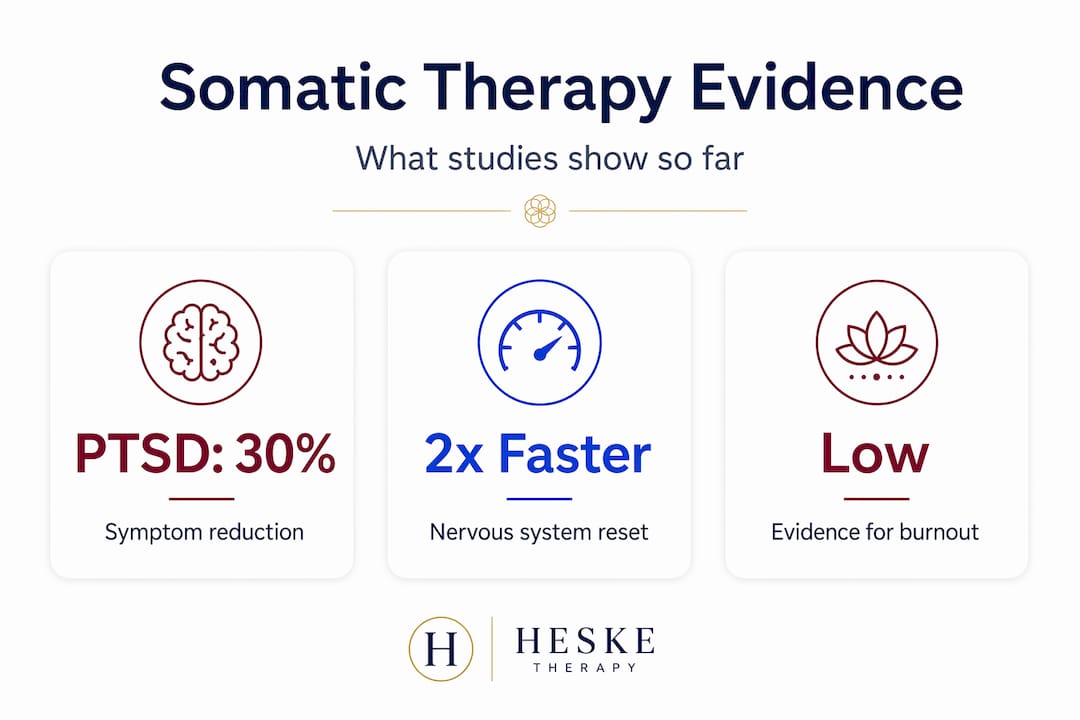
For anxiety and burnout specifically, the picture is less clear. Somatic-informed interventions that target autonomic regulation and distress reduction show promise, but many studies are preliminary and not necessarily specific to somatic therapy as a unified modality. The research often groups different approaches under the same label, making it hard to isolate what is actually working.
Condition | Somatic therapy evidence | Established therapy comparison | Certainty level |
PTSD | Moderate benefit shown | Lower than Prolonged Exposure or EMDR | Low to moderate |
Anxiety disorders | Preliminary, mixed results | Lower than CBT | Low |
Burnout | Very limited data | Lower than CBT or integrative approaches | Very low |
Autonomic regulation | Positive early signals | Comparable to mindfulness-based approaches | Low |
One statistic worth noting: preliminary somatic-informed interventions have shown measurable reductions in autonomic reactivity, such as heart rate variability improvements and cortisol reduction, even when full symptom-level change is not yet confirmed. This suggests the body-level mechanisms are real even if the clinical outcome data needs to mature.
For expats managing trauma and wanting a fuller picture of options, reading about natural trauma recovery can help you place somatic approaches within a broader set of strategies.
Pro Tip: A trustworthy somatic therapist will tell you upfront that the evidence base is still developing. Any practitioner who claims somatic therapy is definitively superior to established approaches is overselling what the current research supports.
Choosing a somatic therapist in Madrid: For expats
Finding qualified mental health support as an English-speaking expat in Madrid involves a specific set of challenges that go beyond simply locating a therapist. Language, cultural context, and modality confusion all matter.
Use this numbered checklist when evaluating somatic therapists in Madrid:
Confirm language capacity first. Therapy conducted in your second language is qualitatively different. Emotional nuance, trust-building, and crisis communication all require fluency. Prioritize therapists who are truly fluent in English, not just conversationally comfortable.
Ask about modality lineage and certification. As established above, somatic therapy is a broad term. Ask specifically which model they practice, which institution certified them, and how recently they completed advanced training.
Explore their pacing protocol. Ask how they would handle a session where you became visibly overwhelmed. A competent practitioner will describe a clear, calm de-escalation process and will not minimize the question.
Inquire about cultural awareness. Expats carry the stress of cultural adjustment, identity shifts, and often complicated relationships with the host country. Ask whether the therapist has experience working with internationally mobile clients.
Check for integrative capacity. The most effective practitioners do not treat somatic therapy as the only tool. Ask whether they combine it with CBT, EMDR, counseling, or other evidence-based methods based on individual need.
Understand the fee and session structure. Burnout recovery, in particular, is rarely a quick fix. Understand the expected number of sessions, the cancellation policy, and whether online sessions are available for periods when you travel.
For expats seeking anxiety and burnout support, a key screening question is whether the therapist can clearly explain their modality lineage, pacing approach, and how they manage risk of destabilization. If the answers are vague, keep looking.
For a broader view of what qualifications and methods look like in practice, examples of therapy methods for expatriates provides useful context. And if location or schedule is a barrier, online therapy for expats in Madrid covers the practical considerations for remote sessions.
Pro Tip: Ask the therapist directly, “What would you do if I became dissociated during a session?” Their answer reveals both their training depth and their comfort with managing risk in the room.
Our perspective: What most guides miss about somatic therapy for expats
Most articles about somatic therapy focus on the techniques. This one has too, because you need that foundation. But here is what gets overlooked: the relationship between safety and effectiveness in body-based work is more critical than in almost any other therapeutic modality.
When you invite someone to direct their attention to their body during a trauma-processing session, you are asking them to lower defenses that exist for good reasons. Dissociation, emotional flooding, and re-traumatization are real risks when somatic work is paced poorly or conducted by a practitioner whose training is thin. This is not an argument against somatic therapy. It is an argument for choosing your therapist with exceptional care.
Expats in Madrid face a particular version of this challenge. The mental health market here, like in many international cities, contains practitioners with widely varying standards. The label “somatic therapist” is not protected in the same way that “clinical psychologist” is in many countries. Anyone can use the term. This makes your screening questions not just useful but essential.
There is also a cultural dimension that does not get enough attention. Moving to a new country fragments your sense of self in ways that are genuinely somatic. The body registers displacement: new smells, unfamiliar food, a different rhythm of daily life, relationships conducted in a second language. For expats, somatic work can be uniquely resonant precisely because so much of the stress of relocation lives in the body before it is ever verbalized.
Our honest view, developed through working with international clients in Madrid, is this: do not fixate on the modality label. Focus on the therapist’s actual skills, their transparency about evidence, their capacity to hold you safely at the edge of your window of tolerance, and their cultural fluency. A skilled integrative therapist who understands trauma recovery techniques and can weave body-awareness into their work will often outperform a rigidly modality-specific practitioner who cannot adapt.
The best outcome happens when you feel genuinely safe, clearly informed, and actively involved in decisions about the pace and direction of your own healing.
Discover somatic-informed and rapid therapies at Heske Therapy in Madrid
If this guide has helped you understand somatic therapy and what to look for in a therapist, the next step is finding a practice that actually meets those standards for English-speaking expats in Madrid.
At Heske Therapy, we offer an integrative approach that brings together body-informed awareness, rapid transformational therapy, EMDR, CBT, and counseling into personalized plans built around your specific situation. Whether you are dealing with anxiety, burnout, trauma, or the accumulated stress of expat life, our sessions are available both in-office in Madrid and online, conducted in English, Spanish, or Dutch. If you are ready to move beyond talking in circles and want a structured, evidence-aware path forward, explore our 21-day RTT package or book a free discovery call to discuss which approach fits you best.
Frequently asked questions
Is somatic therapy effective for trauma or PTSD?
Somatic therapy has shown benefits for PTSD symptoms and co-occurring depression, but current evidence is limited compared to well-established trauma-focused therapies like EMDR or Prolonged Exposure. It can be a valuable part of a treatment plan, especially when combined with other evidence-based methods.
What’s the difference between somatic therapy and talk therapy?
Somatic therapy emphasizes body awareness, physical sensations, and nervous-system regulation, while talk therapy relies primarily on verbal discussion of thoughts, memories, and patterns. The two approaches can work well together in an integrative treatment plan.
Are somatic therapies safe for anxiety and burnout?
Most somatic-informed approaches are considered safe when properly paced, but many studies are preliminary and more research is needed before making strong safety claims for anxiety and burnout specifically. Careful therapist supervision and clear pacing protocols are essential safeguards.
How do I choose a somatic therapist in Madrid?
Ask about specific modality certification, pacing strategies, and how the therapist handles dissociation or emotional flooding. A key screening criterion is whether the therapist can explain their training lineage and risk management approach clearly and without defensiveness.
Recommended
Comments