Trauma Healing – How It Transforms Emotional Well-Being

Starting a new life in Madrid can stir up unexpected stress and emotional roadblocks, especially when old wounds suddenly surface in unfamiliar surroundings. For many English-speaking expatriates, anxiety or emotional blocks do not always come from obvious crises. They often emerge from complex life changes or longstanding pressures. Trauma healing reaches beyond dramatic events and considers any disturbing experience that disrupts daily living. This overview explains how trauma actually works, clears up common misconceptions, and highlights fast, effective therapy solutions designed to help you feel stable, supported, and ready to thrive in your new city.
Table of Contents
Key Takeaways
Point | Details |
Understanding Trauma | Trauma is not limited to extreme events; any significant disturbing experience can affect mental and emotional functioning. |
Misconceptions about Healing | Healing is not always quick or linear; it often requires tailored approaches rather than a one-size-fits-all method. |
Therapy Methods | Various methods like EMDR, CBT, and RTT offer unique mechanisms for trauma processing; selecting the right one is crucial for effective healing. |
Cultural Sensitivity | A therapist’s understanding of cultural context can significantly impact trauma healing, especially for expatriates navigating complex emotional landscapes. |
Defining Trauma Healing and Common Misconceptions
When you hear the word “trauma,” you might picture something dramatic or life-threatening. But here’s what most people get wrong: trauma is far broader than what we typically see in movies. Trauma encompasses any disturbing experience that significantly disrupts your mental, emotional, or physical functioning, whether it stems from obvious crises like accidents and abuse or from experiences that might seem smaller to outsiders. For expatriates navigating life in a new country, trauma can emerge from cultural dislocation, relationship breakdowns, workplace stress, or accumulated pressure that never properly releases. The truth is that your brain doesn’t distinguish between “worthy” and “unworthy” traumatic experiences. It simply registers that something felt threatening, overwhelming, or uncontrollable, and then it responds accordingly.
Trauma healing is the process of resolving the psychological and emotional aftermath of these experiences. It means moving beyond the freeze response your nervous system entered, rebuilding your sense of safety, and restoring your ability to engage fully with life. But misconceptions abound here, and they can prevent people from seeking help or recognizing their own experiences as valid. One major misconception is that trauma only happens from extreme events like war, natural disasters, or violent crime. This narrow view excludes countless people whose suffering is equally real and deserves treatment. Another common misunderstanding is the belief that you should simply “move on” or “be stronger” after something difficult happens. Healing doesn’t work through willpower alone. Your nervous system needs proper support to reorganize itself, which is exactly why approaches like using RTT hypnotherapy to recover from trauma prove so effective for many English-speaking expats in Madrid who’ve tried talking therapy without lasting results.
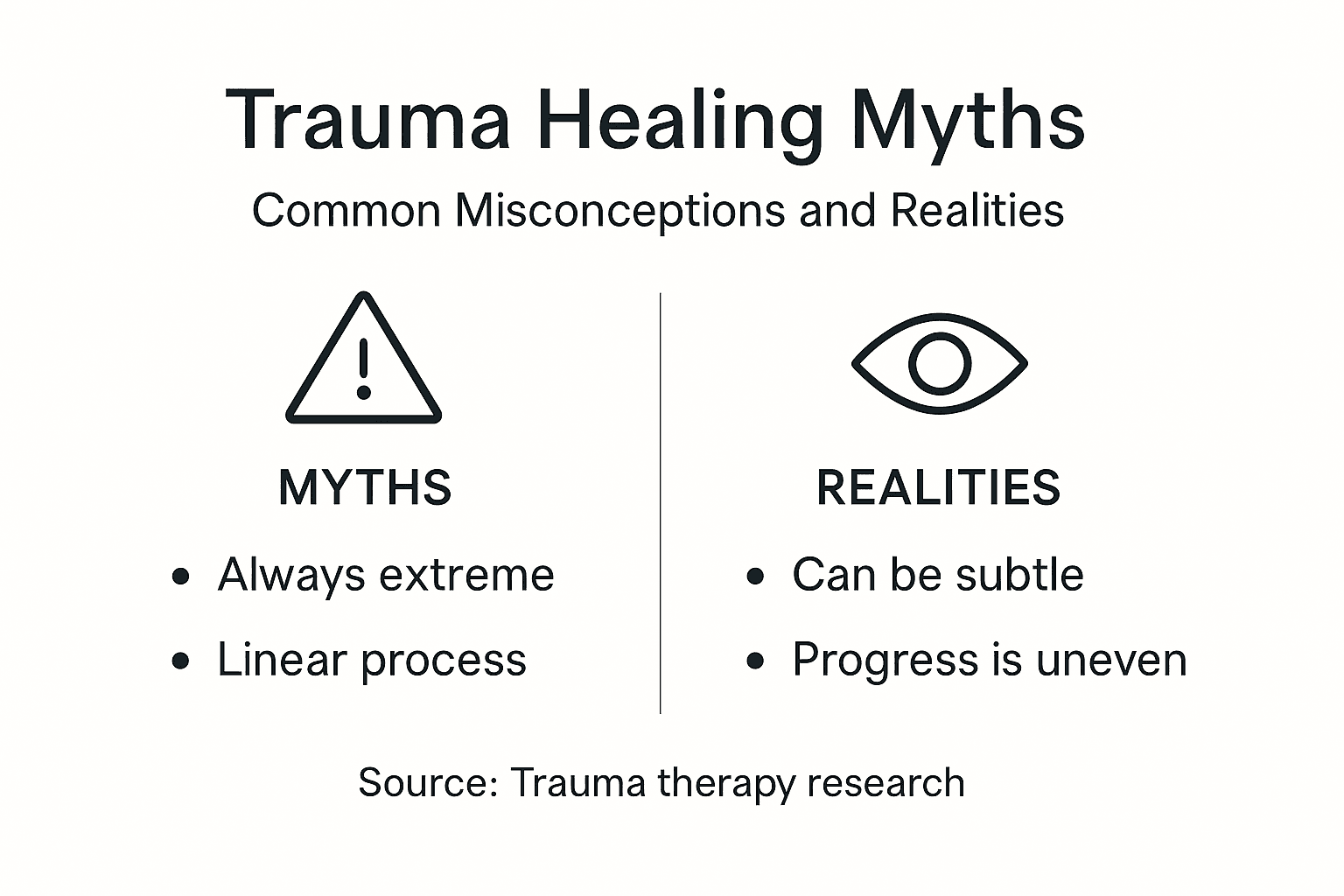
Another widespread misconception is that trauma healing is linear and quick. People expect that once they process what happened, they’ll simply feel better and move forward. Real healing isn’t like flipping a switch. It’s more like gradually turning up the brightness on a dimmed light. Progress happens in layers, with some days feeling like setbacks even as your overall trajectory improves. Some people also mistakenly believe that discussing their trauma repeatedly will heal it. Talking about traumatic events can sometimes reinforce the emotional patterns connected to them, which is why evidence-based approaches that work with both your conscious mind and subconscious responses often generate faster, more lasting transformation than conversation alone.
The final misconception worth addressing is the idea that trauma only affects “certain types of people.” The reality is more complex. Trauma responses depend on individual factors like your baseline nervous system sensitivity, previous experiences, current stress levels, and available support systems. Two people can experience similar events and respond quite differently. As an expat in Madrid, you might carry cumulative stress from leaving your home country, building new social networks, navigating language barriers, and managing career transitions alongside personal challenges. This layered experience can intensify trauma responses in ways that traditional assessment frameworks sometimes miss. Recognizing this helps you understand that your emotional struggles aren’t signs of weakness or inadequacy. They’re evidence that your system needs appropriate support to process what you’ve experienced and return to equilibrium.
Pro tip: When evaluating whether you might benefit from trauma healing, focus not on whether your experience “deserves” to be called trauma, but on whether it’s affecting your daily functioning, relationships, or sense of safety. If your life is being limited by anxiety, avoidance, or emotional blocks, professional support can help, regardless of how your experience compares to others.
Types of Trauma and Healing Approaches
Trauma doesn’t come in one package. Understanding the different types helps you recognize what you’re dealing with and why certain healing methods work better than others. Trauma falls into three main categories: acute, chronic, and complex, each with its own signature impact on your nervous system and emotional life. Acute trauma stems from a single distressing event: a car accident, a sudden loss, a one-time assault. Your nervous system gets shocked, your brain goes into overdrive trying to process what happened, and you experience a concentrated surge of fear and disorientation. Chronic trauma, by contrast, results from prolonged exposure to stressors. For expatriates in Madrid, this might look like months of workplace harassment, ongoing financial instability, or the cumulative weight of feeling perpetually displaced. Your nervous system never fully settles because the threat keeps renewing itself. Complex trauma involves multiple repeated events, often in interpersonal contexts like childhood abuse, domestic violence, or narcissistic relationships. This type fundamentally shapes how you relate to safety, trust, and your own worth. Each type demands different healing approaches because each type has carved different neural pathways in your brain.
Healing approaches must match the trauma type to be effective. For acute trauma, interventions focus on helping your nervous system process the shock and return to baseline functioning. For chronic trauma, the goal shifts toward building sustainable coping strategies and addressing the ongoing stressors. Complex trauma requires longer, deeper work that addresses not just the events themselves but the beliefs you formed about yourself, relationships, and the world as a result of those events. Evidence-based therapies like trauma-focused cognitive behavioral therapy, prolonged exposure therapy, and cognitive processing therapy address the broad spectrum of trauma symptoms across all three categories. What’s crucial is that treatment gets personalized to your specific situation. You might benefit from trauma therapy approaches designed specifically for how emotional wounds develop and heal, which often combines multiple modalities rather than relying on a single technique. Some therapists use rapid transformational approaches that work directly with your subconscious mind to shift the neural patterns associated with trauma, while others use somatic methods that help your body release the frozen responses it’s been holding.
Understanding Which Approach Works for Your Situation
The method that heals your trauma depends on several factors beyond just the trauma type itself. Your personality, your nervous system’s baseline sensitivity, your available support systems, and even practical considerations like your schedule and budget all play roles. Some people respond remarkably well to talk therapy paired with deliberate exposure to avoided situations. Others hit a wall with talking alone because their trauma lives primarily in their body and subconscious responses, not in the rational mind that processes conversation. If you’ve been in traditional therapy without seeing the shifts you need, that’s not a failure on your part. It likely means your particular nervous system and trauma pattern need a different approach. The expat experience adds another layer. Moving to a new country can actually activate dormant trauma or create new trauma responses because you’ve lost familiar support systems and environmental cues that helped regulate your nervous system. This is why personalized treatment planning matters so much. A therapist working with you should explore not just what happened to you, but how your specific brain and body have organized around those experiences.
One important reality: healing timelines vary enormously. Acute trauma might resolve in weeks or months with proper support. Chronic trauma often requires months to years of consistent work. Complex trauma, especially when it started in childhood, typically needs sustained engagement over an extended period. But here’s the encouraging part: healing doesn’t require you to relive your trauma repeatedly or process every detail. Modern trauma therapies work far more efficiently than older talk-based models, often generating significant shifts within 8 to 12 sessions rather than years of weekly appointments. For busy professionals and expatriates juggling work, family, and cultural adjustment, this matters tremendously.
Pro tip: When choosing a healing approach, prioritize finding a therapist who has specific experience with your trauma type and your expat situation, rather than assuming the most popular method will work for you; ask potential therapists directly about their success rates with clients in your demographic and trauma category.
Key Characteristics of Effective Trauma Therapy
Not all therapy works equally for trauma. The difference between a therapy that produces real change and one that simply offers conversation lies in several specific characteristics that separate effective treatment from well-intentioned but ineffective approaches. Effective trauma-focused therapy requires overcoming patients’ ambivalence, establishing a safe environment, and managing distressing emotions in ways that support rather than retraumatize. When you walk into a therapist’s office carrying trauma, you’re carrying contradictions. Part of you wants to heal and move forward. Another part of you fears what might happen if you actually process these experiences. You might fear you’ll fall apart, that talking about it will make it worse, or that revealing what happened means acknowledging a part of yourself you’d rather keep hidden. Effective trauma therapy addresses this ambivalence head-on rather than pretending it doesn’t exist. A skilled therapist recognizes your resistance not as stubbornness but as your nervous system protecting you, and works with that protection rather than against it. This builds the trust that allows you to engage with challenging emotions while feeling supported.

Another hallmark of effective trauma therapy is what’s called trauma-informed care, which sounds bureaucratic but is genuinely transformative in practice. This means your therapist understands that your nervous system has been shaped by threat, that your body might react before your conscious mind catches up, and that control matters deeply when your trauma involved loss of control. A trauma-informed therapist won’t surprise you with sudden techniques, won’t push you faster than you can handle, and recognizes that your symptoms aren’t character flaws. They also understand that evidence-based practices with demonstrated symptom reduction, adaptability to complex presentations, and incorporation of your own preferences create the conditions for lasting change. This means your therapy adapts to you, not the reverse. You’re not forced into a one-size-fits-all protocol. Instead, your therapist draws from multiple approaches, personalized to your specific nervous system, your specific trauma, and your specific goals. For expatriates in Madrid managing the unique stressors of displacement alongside personal trauma, this adaptability is crucial. Your therapist should understand that your anxiety might be intertwined with cultural dislocation, language barriers, and loss of social identity, not just your trauma history.
Building a Strong Therapeutic Alliance
The relationship between you and your therapist is not secondary to the technique. It’s foundational. Research consistently shows that clients who feel genuinely seen, respected, and believed by their therapist recover faster and more completely than those who receive technically perfect therapy from a distant provider. This means your therapist should ask about your experience, listen to your feedback about what’s working and what isn’t, and adjust accordingly. If something doesn’t feel right, you should feel safe saying so. A good trauma therapist welcomes that feedback rather than becoming defensive. They also maintain appropriate boundaries while creating genuine human connection. You need to feel that this person is competent and has helped others recover from similar experiences, but you also need to feel that they genuinely care about your wellbeing, not just as a clinical case but as a person.
Effective trauma therapy also builds resilience and skill-building alongside trauma processing. You’re not just excavating painful memories in hopes they’ll lose power. You’re also developing concrete tools for managing your nervous system when it gets activated, strengthening your sense of agency, and identifying strengths within yourself that trauma may have obscured. This might include grounding techniques, somatic awareness practices, or cognitive tools that interrupt the automatic thought patterns trauma has wired into your brain. For busy professionals and expatriates, you need approaches that deliver results efficiently. Rapid transformational approaches to anxiety relief are particularly valuable because they work with your subconscious patterns directly rather than relying on conscious insight alone, often producing significant shifts within weeks rather than years. The most effective trauma therapies combine intellectual understanding with nervous system reorganization, which is why modern trauma treatment looks different from traditional talk therapy.
Pro tip: In your first session with a trauma therapist, notice whether they ask about your specific experience, explain their approach clearly, and check in about what you need to feel safe; these initial interactions reveal whether they have the trauma-informed foundation that predicts successful outcome.
Therapy Methods: EMDR, CBT, RTT, and More
When it comes to treating trauma, you have options. The challenge is understanding how different approaches work so you can identify which might be right for your nervous system and your specific situation. The most researched and established methods are EMDR and CBT, both of which have decades of clinical evidence backing their effectiveness. EMDR and CBT are among the most studied and effective treatment modalities for post-traumatic stress disorder, with strong track records of symptom reduction across diverse trauma types. Eye Movement Desensitization and Reprocessing (EMDR) works through a fascinating mechanism: you recall your traumatic memory while your eyes follow a therapist’s moving finger or light, or while you experience bilateral stimulation through tapping or sound. This simultaneous activation of both sides of your brain while processing the trauma appears to help your nervous system reorganize its response to the memory. The trauma doesn’t disappear, but it loses its emotional charge. You can think about what happened without your body flooding with fear. EMDR is evidence-supported for reducing PTSD symptoms and works well even in intensive remote formats, making it particularly accessible for expatriates juggling work schedules or living in areas with limited trauma specialists.
Cognitive Behavioral Therapy (CBT) takes a different approach. Rather than relying on eye movements, CBT focuses on the relationship between your thoughts, feelings, and behaviors. After trauma, your brain develops predictable patterns: you think “something bad will happen,” you feel fear, and you avoid situations that trigger those thoughts. CBT interrupts this cycle by helping you examine whether your thoughts accurately reflect reality, gradually exposing yourself to avoided situations in a controlled way, and building new behavioral responses. CBT adapts well to trauma-focused delivery and emphasizes both processing traumatic memories safely and building concrete coping skills you can use in daily life. The beauty of CBT is its practicality. You’re not just talking about what happened. You’re actively changing how you respond to thoughts and situations. For busy professionals managing anxiety alongside work responsibilities, this skill-building component offers tangible relief you can apply immediately.
Understanding Rapid Transformational Therapy
Then there’s Rapid Transformational Therapy (RTT), which represents a different philosophical approach. While EMDR and CBT work primarily with your conscious and semiconscious mind, RTT combines hypnosis and psychotherapy for trauma healing by accessing your subconscious patterns directly. Hypnosis might sound intimidating or fake, but in therapeutic contexts it’s simply a state of focused attention where your critical mind relaxes and your subconscious becomes more receptive. In this state, you can trace your trauma response back to its origin, understand the protective purpose it was serving, and install new responses at the subconscious level. Many expatriates report that RTT produces rapid results for anxiety relief because it bypasses the analytical resistance that sometimes limits progress in talk therapy. Instead of spending weeks convincing yourself intellectually that your fear is irrational, RTT works directly with the part of your mind that holds the fear.
Here is a summary of the main trauma therapy methods and what makes each one distinct:
Therapy Method | Main Mechanism | Typical Beneficiaries | Unique Advantage |
EMDR | Bilateral brain stimulation during memory recall | People with vivid flashbacks or PTSD | Reduces emotional charge of traumatic memories |
CBT | Restructuring thoughts and gradual exposure | Individuals who prefer logic-driven change | Practical coping skills for daily life |
RTT | Hypnosis to access subconscious patterns | Those stuck after talk therapy or deep-rooted trauma | Direct subconscious rewiring for rapid shifts |
Choosing between these methods depends on your personality, your trauma type, and your goals. If you’re highly analytical and benefit from understanding the logic behind your healing, CBT might appeal to you. If you experience intrusive images or flashbacks that feel resistant to rational discussion, EMDR’s bilateral stimulation can be remarkably effective. If you’ve tried traditional talk therapy without the shifts you needed, or if you’re dealing with deep-seated patterns that feel immune to conscious effort, RTT’s subconscious focus might unlock what’s been stuck. Many therapists use combinations of approaches rather than adhering strictly to one method. An effective trauma therapist draws from multiple modalities, selecting techniques based on what your particular nervous system needs in any given moment. For expats navigating the layered stress of displacement plus personal trauma, this flexibility matters tremendously. Your therapist should understand that your anxiety might respond differently depending on whether it’s rooted in your trauma history, your current expat circumstances, or a combination of both. The right approach meets your nervous system where it actually is, not where theory says it should be.
Pro tip: Ask potential therapists directly which methods they use and why they chose them; listen for whether they describe a flexible, personalized approach or a one-size-fits-all protocol, as this reveals whether they’ll adapt their technique to your actual needs rather than forcing you into their preferred framework.
Risks, Barriers, and Cultural Factors in Healing
Trauma healing isn’t a straight path for anyone, but for expatriates, the obstacles can feel especially complicated. You’re not just dealing with your trauma. You’re navigating it across cultural boundaries, in a language that may not be your first, with support systems fractured by distance, and within a context where your home culture’s understanding of mental health might differ drastically from Madrid’s approach. The barriers you face are real, systemic, and worth understanding so you can prepare for them rather than being blindsided. Cultural concepts of distress play a significant role in how trauma is experienced and expressed worldwide, which means your therapist needs to understand not just trauma in general, but trauma as it manifests in your specific cultural context. If you come from a background where emotional expression is considered private or even shameful, traditional talk therapy might feel alien or wrong regardless of how effective it might be for others. If your culture understands distress through physical symptoms rather than emotions, a therapist unfamiliar with this difference might misinterpret your presentation. This is why cultural responsiveness matters so much. A therapist working with you should ask about your cultural background, your family’s attitudes toward mental health, and how you’ve been taught to understand and express emotional pain.
One of the most significant barriers expatriates face is isolation. When you’re living abroad, the support systems that normally buffer trauma don’t function the way they did at home. Your family isn’t around for Sunday dinners or emergency phone calls at 2 a.m. Your childhood friends don’t understand your current situation because they’re not living it. Even your partner or spouse, if you have one, is often caught in the same disorientation you are. This creates what researchers call normalization of trauma exposure, where ongoing stress from displacement, language barriers, cultural differences, and separation from roots becomes so constant that you stop recognizing it as trauma. You’re just tired. You’re just stressed. You’re just managing. But cumulative stress is still stress, and your nervous system doesn’t differentiate between acute crisis and chronic low-level threat. Culturally responsive trauma-informed services emphasize understanding societal, community, and individual barriers, recognizing that factors like socioeconomic status, access to culturally matched providers, and the weight of being a minority in your community all impact your ability to heal.
Navigating Stigma and Access Challenges
Another substantial barrier is stigma, particularly if your cultural background carries strong shame around mental health treatment. In some cultures, admitting you need therapy is seen as weakness or failure. The idea of “airing family business” to a stranger feels wrong. You might hear internal messages like: “We don’t do therapy in my family. We just handle things.” Or: “If I admit something is wrong, I’m admitting defeat.” This internal conflict can delay seeking help even when you desperately need it. Add language barriers on top of this. Even if you speak English fluently for work, processing trauma requires nuanced emotional language. You might find yourself unable to express what you’re feeling because the words exist in your native language but not in English, or they carry different emotional weight. A skilled therapist working with expatriates will slow down, check understanding, and sometimes help you find the words in whatever language holds them most accurately.
Access itself presents challenges. Mental health services in Madrid are developing, but finding an English-speaking trauma specialist who understands expat experience takes work. Insurance coverage varies widely depending on your visa status and employment situation. Cost becomes a barrier when therapy isn’t covered and you’re already managing the financial stress of living internationally. There’s also the barrier of not knowing what’s normal. When you’re navigating expat life, which stressors are normal cultural adjustment and which are trauma responses? This ambiguity can prevent you from seeking help until your symptoms become severe. Building emotional resilience as an expat requires understanding how your specific cultural context shapes your healing journey, including recognizing when you need professional support beyond resilience-building. The risk, if barriers go unaddressed, is that unprocessed trauma becomes chronic, festering under the surface while you maintain your professional and social facade. It can manifest as physical illness, relationship problems, or sudden emotional collapse when stress exceeds your capacity to manage it.
This table outlines common barriers for expatriates seeking trauma healing and strategies to address them:
Barrier | Impact on Expatriates | Recommended Solution |
Isolation | Weak support networks, normalization of stress | Build new communities, seek group therapy |
Cultural stigma | Reluctance to seek help, shame | Find culturally sensitive therapists |
Language barriers | Difficulty expressing emotions | Use bilingual providers or language-facilitated therapy |
Access/cost | Limited specialist availability | Utilize telehealth and check insurance options |
Pro tip: When seeking a trauma therapist as an expatriate, prioritize finding someone who explicitly asks about your cultural background and expat experience rather than applying a one-size-fits-all approach; their willingness to slow down, use your preferred language when possible, and acknowledge how displacement compounds trauma is a stronger indicator of fit than their general credentials alone.
Discover Transformational Trauma Healing Tailored for Expats in Madrid
Trauma can deeply impact your daily life and sense of safety, especially when compounded by the challenges of living abroad. If anxiety, emotional blocks, or unresolved trauma hold you back, you are not alone. At Heske Therapy, we specialize in addressing the complex layers trauma creates for English-speaking expatriates by combining proven methods like Rapid Transformational Therapy (RTT), EMDR, and CBT. Our personalized and culturally sensitive approach supports rebuilding safety and restoring emotional well-being so you can thrive in your new environment.
Ready to move beyond survival and embrace genuine healing? Take the first step today by scheduling a free discovery call with one of our trauma-informed therapists. Learn how our expert care at Heske Therapy can offer rapid and lasting relief adapted specifically to your experiences as an expat. Explore more about our trauma therapy approach and how we use RTT hypnotherapy to recover from trauma. Your path to transformation starts now.
Frequently Asked Questions
What is trauma healing?
Trauma healing is the process of resolving the psychological and emotional aftermath of disturbing experiences that disrupt mental, emotional, or physical functioning. It allows individuals to rebuild their sense of safety and engage fully with life.
How do I know if I need trauma healing?
If your experiences are affecting your daily functioning, relationships, or sense of safety, professional support may be beneficial. Signs include anxiety, avoidance behaviors, and emotional blocks.
What are the different types of trauma?
Trauma can be classified into three main types: acute trauma (from a single event), chronic trauma (from prolonged exposure to stressors), and complex trauma (from multiple repeated events). Each type requires different healing approaches.
What therapies are effective for trauma healing?
Evidence-based therapies effective for trauma healing include Eye Movement Desensitization and Reprocessing (EMDR), Cognitive Behavioral Therapy (CBT), and Rapid Transformational Therapy (RTT). Each method targets trauma differently and may be more suitable based on individual needs.
Recommended
Comments