What Is Trauma-Informed Care, and Why Does It Matter?

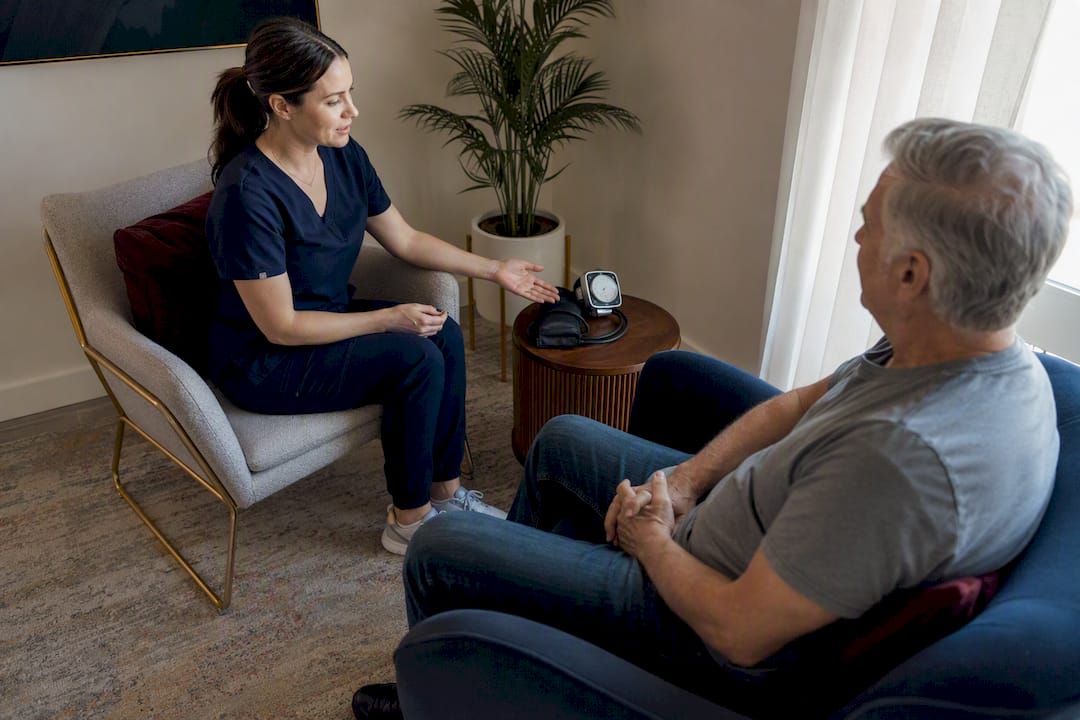
Trauma-informed care is an approach to health and social services that recognizes how common trauma is, understands its effects on the body and mind, and structures every interaction to build safety and trust instead of accidentally causing more harm. It shifts the guiding question from “what’s wrong with you” to “what happened to you.”
SAMHSA’s framework names six core principles, and the University at Buffalo Institute notes that embedding them fully across an organization usually takes several years.
This guide covers the principles, real-world examples, and the steps a practice or clinic actually takes to become trauma-informed.
Table of Contents
What Are the Core Principles of Trauma-Informed Care?
Understanding trauma-informed care starts with six principles that SAMHSA outlines as the backbone of the approach. They aren’t a rigid checklist. They’re values that get adapted to each setting, whether that’s a hospital, a school, or a therapy office.
Safety. People feel physically and emotionally secure in the space and with the people around them.
Trustworthiness and transparency. Decisions and procedures are explained clearly, with no hidden agendas.
Peer support. People with lived experience of trauma or adversity are included as a resource, not sidelined.
Collaboration and mutuality. Power is shared between staff and the person receiving care, not held entirely by the provider.
Empowerment, voice, and choice. People get real options and a say in their own treatment, rather than being told what will happen to them.
Cultural, historical, and gender responsiveness. Practices account for a person’s background, including historical or generational trauma tied to race, gender, or displacement.
These map closely to what SAMHSA’s public guidance describes as the foundation for trauma-informed programs nationwide.
Pro Tip: Build transparency into intake by telling clients exactly what will happen in the first session and why you’re asking each question. A simple line like “I’m asking about your sleep because it often connects to stress” turns a clinical checklist into a collaborative conversation.
What Are the Benefits of Trauma-Informed Practices?
For the person receiving care, a trauma-informed approach tends to mean:
Feeling safer and more willing to disclose sensitive information.
Greater trust in the provider, which supports a stronger therapeutic alliance.
Fewer moments that feel invasive, confusing, or re-traumatizing.
For organizations, the payoff shows up operationally:
Fewer missed appointments, since people feel less anxious about showing up.
Better staff retention, because trauma-informed workplaces also protect employees from burnout.
Smoother service delivery overall, since misunderstandings and conflict drop.
Both SAMHSA and the University at Buffalo Institute frame trauma-informed approaches as central to modern service delivery, not an optional add-on.
What Do Trauma Responses Look Like in Practice?
Trauma doesn’t always look like distress. It can look like silence, irritability, or a person who seems perfectly fine on the surface. Recognizing the range of responses helps providers avoid misreading behavior as defiance or disinterest.
Hyperarousal. Jumpiness, a racing heart, or an exaggerated startle response.
Hypoarousal or numbing. Flat affect, checking out, or seeming disconnected from the conversation.
Dissociation. Losing track of time or feeling detached from one’s own body during a stressful moment.
Avoidance. Skipping appointments, dodging certain topics, or minimizing symptoms.
Emotional reactivity. Sudden anger, tears, or shutting down when a topic hits too close.
Somatic symptoms. Headaches, stomach issues, or chronic pain with no clear physical cause.
A patient who goes silent during a physical exam isn’t necessarily uncooperative. That silence can be the body’s own protective response, and treating it as resistance often makes things worse.
Cultural background shapes how trauma responses show up, so providers should never assume trauma based on behavior alone.
What Does Trauma-Informed Care Look Like Across Settings?
In a healthcare visit, a nurse explains each step before touching a patient: “I’m going to check your blood pressure now, is that okay?” That small pause hands control back to the patient.
In a social-services intake, a caseworker offers a choice about pacing: “We can cover your housing situation first or your income details first, whichever feels easier to start with.” That’s a low-cost way to build empowerment into a form most people dread filling out.

In a school setting, a counselor lets a student pick where to sit during a difficult conversation instead of assigning a chair across a desk. Removing that physical power imbalance often changes the entire tone of the exchange.
None of these examples require diagnosing anyone or delivering clinical treatment. They’re universal precautions, the same way handwashing protects against illness whether or not anyone in the room is currently sick.
Pro Tip: Script two or three go-to phrases for your team that offer choice (“Would you rather start with A or B?”) and post them somewhere staff can glance at during a shift. Consistency across a team builds trust faster than any single well-meaning gesture.
How Do You Build a Trauma-Informed Organization?
Becoming trauma-informed is a structural shift, not a training you complete once. Here’s a sequence that works:
Get leadership buy-in. Change stalls without visible commitment from the top.
Train all staff, including front-desk and administrative roles, not just clinicians.
Review policies for anything that removes choice or dignity unnecessarily, like inflexible intake forms.
Adjust the physical environment, from waiting room layout to exam room privacy.
Support the workforce with supervision and reasonable caseloads, since burned-out staff can’t sustain trauma-informed care.
Measure and adjust using client feedback and incident tracking, then repeat.
Early, low-cost priorities include:
Rewriting intake questions to explain their purpose.
Training reception staff on de-escalation basics.
Adding a private space for sensitive conversations.
Pro Tip: Start with staff support and small policy tweaks before attempting a full facility redesign. The University at Buffalo Institute notes that fully embedding these values across an organization typically takes three to five years, so sequence your wins.
Trauma-Informed Care vs. Trauma-Specific Treatment
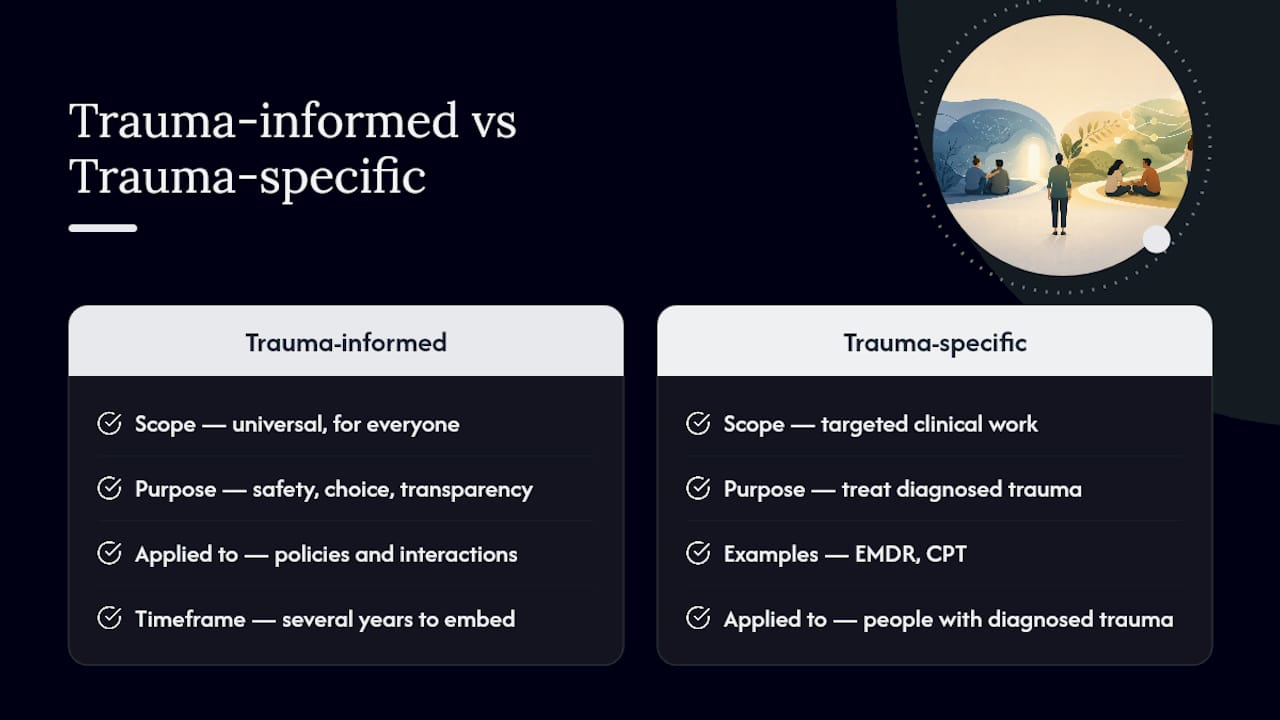
Trauma-informed care is the universal, organization-wide culture. Trauma-specific treatment is the targeted clinical work.
Trauma-informed: applies to every interaction, regardless of whether a person has disclosed trauma.
Trauma-specific: clinical modalities like EMDR or Cognitive Processing Therapy, delivered by a trained clinician to treat diagnosed trauma directly.
Certain practices risk re-traumatizing people even in well-meaning settings: physical restraint, procedures done without explanation, or blunt questions about trauma history in a public waiting area.
Avoiding re-traumatization isn’t about eliminating every hard conversation. It’s about giving people warning, choice, and control over how those conversations happen.
For people who need targeted treatment, connecting with a trauma-focused therapy provider matters more than any universal policy change.
Why Cultural Context Shapes Trauma-Informed Care
Trauma doesn’t affect everyone the same way, and a sociocultural perspective from the National Center for Biotechnology Information makes clear that effective care requires organizational adaptation, not a one-size-fits-all script. Historical and generational trauma, tied to displacement, discrimination, or immigration, shapes how people respond to care long before they walk through the door.
Practical steps toward cultural responsiveness include:
Involving community voices when designing intake and outreach materials.
Providing genuine language access, not just translated forms but interpreters who understand context.
Centering equity and historical trauma in staff training, following guidance from the UK government’s working definition of trauma-informed practice.
For expatriates and multicultural clients specifically, multicultural therapy approaches address language and cultural gaps that generic trauma-informed training often misses.
A Foundation Worth Building Slowly
Trauma-informed care requires universal safety, transparency, and choice built into everyday operations, not a specialized program reserved for people who disclose trauma directly.
Point | Details |
Six core principles | Safety, trustworthiness, peer support, collaboration, empowerment, and cultural responsiveness guide every interaction. |
Universal, not diagnostic | Trauma-informed practices apply to everyone, regardless of whether trauma has been disclosed. |
Organizational timeline | Full implementation across policy, environment, and staff typically takes several years. |
Watch for re-traumatization | Restraint, undisclosed procedures, and blunt questioning can undo trust quickly. |
Trauma-specific care is separate | Diagnosed trauma still requires targeted clinical treatment like EMDR or CBT. |
Getting Support That Actually Understands Trauma
If you recognize yourself in the trauma responses described above, an organization committing to these principles is only part of the equation. The other part is finding a therapist trained specifically in trauma work. Hesketherapy works with expats and English-speaking clients in Madrid using EMDR, Rapid Transformational Therapy, and CBT, tailored to each person’s history and cultural background. You can book a session directly or explore the four-session counseling package if you’re looking for structured, short-term support.
What People Get Wrong About Trauma-Informed Care
Most explanations of trauma-informed care stop at the principles and call it a day. That’s the gap. Principles without sequencing become a poster on a break room wall, not a practice.
The conventional advice treats trauma-informed care like a training module: attend a workshop, get a certificate, move on. What the research actually supports is slower and less satisfying to market. The University at Buffalo’s own timeline, three to five years for full organizational embedding, tells you this is culture change, not compliance training.
Here’s what I’d prioritize first if I were running a clinic or a school program: staff support before physical redesign. A burned-out receptionist can undo a beautifully renovated waiting room in one bad interaction. Culture spreads through people, not paint color.
The other overlooked piece is cultural specificity. Generic trauma-informed training often assumes a single cultural default. For expat and immigrant populations especially, that assumption quietly recreates the same power imbalance the framework was built to dismantle.
Frequently Asked Questions
What is trauma-informed care in simple terms? It’s an approach where every policy and interaction assumes trauma might be present, so providers build in safety, choice, and transparency by default rather than reacting only after trauma is disclosed.
How is trauma-informed care different from trauma-specific treatment? Trauma-informed care is a universal culture applied to everyone. Trauma-specific treatment, like EMDR or CPT, is targeted clinical work for people with diagnosed trauma.
How long does it take to become a trauma-informed organization? The University at Buffalo Institute notes it typically takes several years to fully embed trauma-informed values across policy, environment, and workforce.
Can trauma-informed practices actually re-traumatize someone if done wrong? Yes. Practices like physical restraint, undisclosed procedures, or blunt trauma-history questions in public settings can undo trust and cause harm even in well-intentioned programs.
Where can I learn more about implementing trauma-informed care? Start with SAMHSA’s guidance and the GOV.UK working definition for practical frameworks, or explore trauma recovery techniques for individual next steps.
This article is general information, not a substitute for advice from a qualified doctor. Consult a qualified healthcare professional about your own circumstances before acting on anything here.
Sources
Recommended
Comments