Why Address Mental Health Stigma: A 2026 Guide


TL;DR:
Mental health stigma is a primary barrier to care, causing individuals to delay or abandon treatment due to shame and fear. Reducing stigma through social contact, recovery narratives, and strategic disclosure can significantly improve help-seeking behavior and community well-being. Addressing all levels of stigma leads to earlier intervention, better outcomes, and stronger systemic support for mental health.
Mental health stigma is defined as the collection of negative beliefs, stereotypes, and social penalties directed at people with mental health conditions, and it is the single most powerful barrier preventing people from getting care. The CDC identifies stigma as a primary barrier to treatment, causing individuals to delay or abandon help out of fear and shame. Organizations like Mental Health America, SANE, and the CDC have spent decades documenting its damage, and the 2026 data makes the case for urgency clearer than ever. Understanding why address mental health stigma matters is not an academic exercise. It is the foundation of any serious effort to improve mental health outcomes at every level of society.
Why address mental health stigma and what’s at stake
Stigma does not just hurt feelings. It produces measurable, life-altering harm that compounds over time. Stigma delays care and makes treatment adherence harder, which directly worsens long-term mental health outcomes. The consequences operate across three interconnected areas: the individual, the family, and the broader community.

Consider what happens when someone avoids a diagnosis because they fear being labeled “crazy” at work. They do not just miss one appointment. They miss months or years of treatment, often reaching crisis point before seeking help. This pattern is not rare. According to SANE’s 2025 National Stigma Report Card, more than two-thirds of people with mental health problems report that stigma and discrimination are more damaging than their symptoms. That finding reframes the entire conversation: the social response to mental illness often causes more suffering than the illness itself.
The harm extends well beyond the clinic. People with mental health conditions face discrimination in hiring, housing, and social relationships. Families carry shame that prevents them from discussing struggles openly, which isolates the person who needs support most. Communities lose productive members and bear higher healthcare costs when conditions go untreated.
The treatment gap is also structural. Approximately 137 million Americans live in mental health professional shortage areas in 2026. Stigma makes that gap worse by suppressing demand for services, reducing political will to fund them, and discouraging people from entering the mental health profession.
The consequences of inaction, ranked by severity, include:
Delayed or abandoned treatment, leading to crisis-level deterioration
Higher relapse rates due to treatment discontinuation driven by shame
Workplace and housing discrimination that reduces economic stability
Social isolation that deepens depression and anxiety
Systemic underfunding of mental health services because stigma minimizes perceived need
“Discrimination is often worse than the illness itself.” SANE’s 2025 National Stigma Report Card
How does stigma operate at public, individual, and institutional levels?
Mental health stigma functions simultaneously at three distinct levels, and each one reinforces the others. Addressing only one level while ignoring the rest leaves the system largely intact.
Public stigma refers to the stereotypes and negative attitudes held by society at large. It shows up in media portrayals of people with mental illness as violent or incompetent, in casual language that uses clinical terms as insults, and in the social distancing behavior that people with mental health conditions routinely experience. Public stigma shapes the environment in which individuals decide whether to seek help.
Self-stigma, sometimes called internalized stigma, occurs when a person absorbs those public attitudes and applies them to themselves. The result is shame, self-blame, and a belief that they do not deserve help or are too weak to need it. Self-stigma is particularly destructive because it operates silently, inside the person’s own mind, making it harder to identify and challenge.
Institutional stigma is embedded in policies, laws, and organizational practices. It appears in insurance systems that reimburse physical health treatment at higher rates than mental health treatment, in workplaces without mental health leave policies, and in criminal justice systems that criminalize mental illness rather than treating it. Institutional stigma is the hardest to dismantle because it requires systemic change, not just attitude shifts.
The three levels interact in a cycle. Public stigma creates institutional barriers. Institutional barriers signal to individuals that mental illness is shameful. Individuals internalize that shame and avoid help. Their avoidance reinforces the public perception that mental illness is rare or manageable without professional support. Breaking this cycle requires pressure at all three levels simultaneously, which is why failing to address stigma at all levels creates a massive gap where individuals avoid help to escape labeling.
Key manifestations at each level include:
Public: Media stereotypes, social distancing, casual use of terms like “psycho” or “schizo”
Self: Shame-based avoidance, self-blame, reluctance to disclose to family or employers
Institutional: Inadequate insurance parity, lack of workplace mental health policies, criminalization of mental illness
What evidence-based strategies effectively reduce mental health stigma?
The research on stigma reduction is more specific than most people realize. Not all approaches work equally well, and some popular methods have weak evidence behind them.
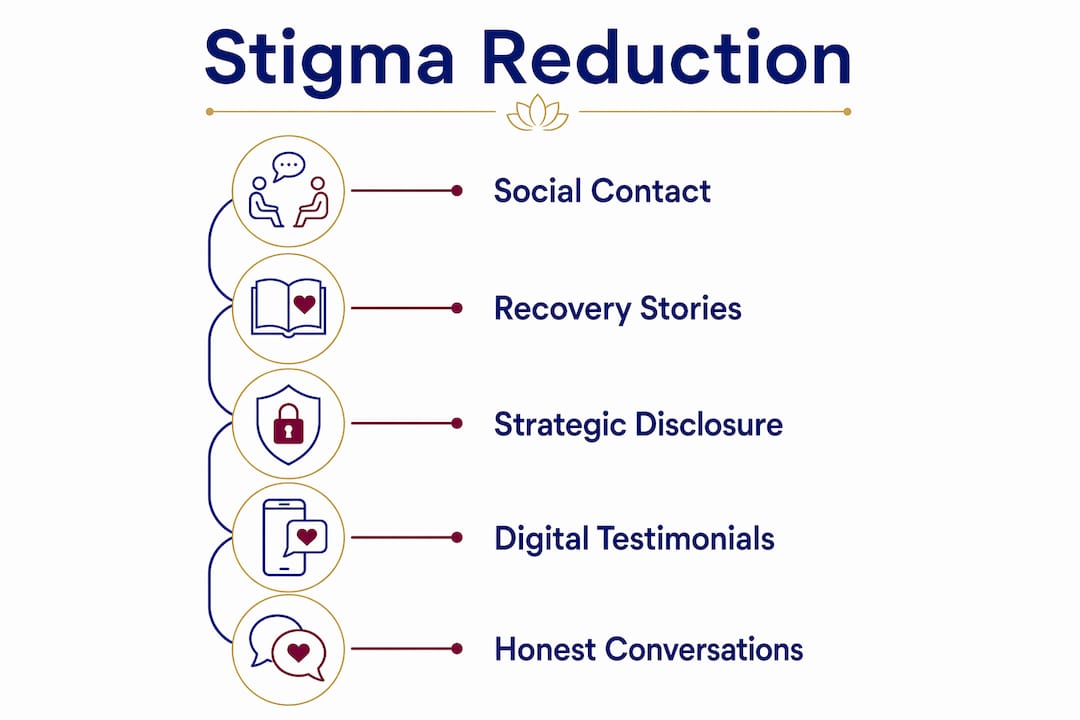
Recovery narratives combined with factual information are more effective than facts alone at shifting attitudes. When someone hears a real person describe their experience with depression, anxiety, or psychosis and then recover, it disrupts the stereotype that mental illness is permanent or defines a person. Psychoeducation without that human element tends to inform without changing behavior.
Social contact is the most consistently effective method across the research literature. Online interventions using this approach show an 87.5% success rate in increasing help-seeking intentions. That figure comes from 14 out of 16 community-based studies, which means the effect is replicable across different populations and settings.
Digital video testimonials are particularly powerful when the person sharing their story matches the demographic of the audience. They break the “people like me don’t seek help” myth that keeps many people, especially men and members of minority communities, from accessing care. This is one reason online counseling access has become a meaningful part of stigma reduction strategy, not just a convenience.
Strategic disclosure is another tool that reduces self-stigma without exposing individuals to unnecessary discrimination risk. Rather than full public disclosure, strategic disclosure means carefully choosing when, what, and to whom you share about your mental health. This reduces the concealment burden, which itself causes stress, while managing real-world discrimination risks in professional settings.
Strategy | Mechanism | Evidence strength |
Social contact and recovery narratives | Disrupts stereotypes through personal connection | Strongest: 87.5% success rate in help-seeking studies |
Psychoeducation with contact | Combines facts with human experience | Strong when paired with contact, weak alone |
Digital video testimonials | Demographic matching breaks “not for me” myths | Strong in community-based studies |
Strategic disclosure | Reduces concealment burden, manages discrimination risk | Moderate: effective for self-stigma reduction |
Language and media advocacy | Shifts cultural norms over time | Long-term impact, harder to measure short-term |
Pro Tip: If you want to support stigma reduction in your community, share a personal or witnessed recovery story alongside any factual information you post. The combination is what changes minds, not the statistics alone.
Mental Health America’s 2026 Action Guide emphasizes that daily honest conversations are among the most accessible tools available. You do not need a platform or a policy role. Normalizing the topic in everyday interactions reduces the social cost of disclosure for everyone around you.
What are the benefits of addressing mental health stigma?
Reducing stigma produces concrete, measurable improvements at every level. These are not aspirational outcomes. They are documented results from communities and systems where stigma reduction has been prioritized.
When stigma decreases, treatment-seeking increases. People enter care earlier, before conditions become severe, which means shorter treatment timelines and better outcomes. Therapy works better when clients are not fighting shame at the same time they are trying to process trauma or manage anxiety. Addressing the social barriers to care is therefore not separate from clinical treatment. It is part of it.
Social inclusion improves when communities stop treating mental illness as a character flaw. People with mental health conditions participate more fully in workplaces, families, and civic life when they are not managing constant fear of exposure. This has economic consequences too: higher workforce participation, lower absenteeism, and reduced emergency healthcare costs.
Advocacy gains momentum when stigma loses its grip. Legislators fund mental health services when constituents demand them openly. Employers create mental health policies when employees feel safe enough to ask for them. The importance of mental health awareness becomes self-reinforcing once enough people are willing to speak about their experiences without shame.
The benefits of addressing mental health stigma include:
Earlier treatment entry, which improves prognosis across most conditions
Higher treatment adherence, reducing relapse rates
Reduced workplace discrimination and improved professional stability
Stronger social support networks for people in recovery
Systemic policy changes that expand access and funding
Connection is protection: personal, honest interactions in everyday life are among the most powerful tools for reducing stigma at the community level. The research supports what most people intuitively understand. Knowing someone with a mental health condition, and seeing them thrive, changes attitudes more reliably than any public campaign.
Statistic callout: More than two-thirds of people with mental health problems say discrimination is more damaging than their symptoms. Addressing stigma is not a secondary concern. It is the primary intervention.
Key takeaways
Addressing mental health stigma is the most direct way to close the treatment gap, improve individual outcomes, and build communities where people seek help without shame.
Point | Details |
Stigma causes more harm than symptoms | Over two-thirds of people with mental illness report discrimination as more damaging than their condition itself. |
Stigma operates at three levels | Public, self, and institutional stigma reinforce each other and must all be addressed for real change. |
Social contact is the most effective strategy | Online contact-based interventions show an 87.5% success rate in increasing help-seeking intentions. |
Strategic disclosure reduces self-stigma | Carefully managing what you share reduces concealment stress without exposing you to unnecessary discrimination. |
Reducing stigma improves systemic outcomes | Earlier treatment entry, higher adherence, and stronger advocacy all follow when stigma decreases. |
What I’ve learned from working with clients who carry stigma
Working with expatriates in Madrid, I see a specific version of this problem every week. Many of my clients have spent years managing anxiety, burnout, or trauma in silence because seeking help felt like admitting failure. For expats especially, there is an added layer: being far from home already feels vulnerable, and admitting to a mental health struggle on top of that can feel like proof that the move was a mistake.
What I have found is that the shame is almost always the harder problem to treat than the condition itself. A client can make rapid progress on anxiety symptoms once they stop spending energy hiding the fact that they have anxiety. That shift, from concealment to acceptance, is where the real work begins.
The misconception I encounter most often is that addressing stigma means broadcasting your struggles publicly. It does not. Strategic disclosure, choosing carefully who you tell and when, is a legitimate and effective approach. You do not owe anyone your diagnosis. What you do owe yourself is the freedom to seek help without shame.
My recommendation for anyone reading this: start with one honest conversation. Not a public post, not a formal disclosure at work. Just one person you trust. Treating stress proactively before it becomes crisis is possible, but only if you let someone in first. That single conversation is often what breaks the cycle.
— Heske
How Hesketherapy supports you in overcoming stigma-related barriers
At Hesketherapy, the work begins before the first session. Many clients arrive carrying years of self-stigma alongside the condition they came to treat. The approach at Hesketherapy combines RTT Therapy, EMDR, CBT, and hypnotherapy to address both the mental health condition and the shame that has built up around it. Sessions are available online and in-office in Madrid, in English, Spanish, and Dutch, making care accessible to international clients who often face additional barriers to seeking help. If you are ready to take the first step without judgment, book a free discovery call with Hesketherapy today.
FAQ
What is mental health stigma?
Mental health stigma is the set of negative beliefs, stereotypes, and social penalties attached to mental health conditions. It operates at public, individual, and institutional levels and is identified by the CDC as a primary barrier to treatment.
Why does mental health stigma prevent people from seeking help?
Stigma creates fear of judgment, discrimination, and social rejection, which causes people to delay or avoid care entirely. SANE’s 2025 National Stigma Report Card found that over two-thirds of people with mental illness report discrimination as more damaging than their symptoms.
What is the most effective way to reduce mental health stigma?
Social contact combined with recovery narratives is the most evidence-backed method. Online contact-based interventions show an 87.5% success rate in increasing help-seeking intentions across community-based studies.
How does self-stigma differ from public stigma?
Public stigma refers to societal stereotypes and attitudes, while self-stigma occurs when an individual internalizes those attitudes and applies them to themselves. Self-stigma produces shame and self-blame that directly suppresses help-seeking behavior.
Can therapy help with stigma-related shame?
Yes. Therapeutic approaches like therapy for stigma directly address internalized shame and help clients develop healthier self-perceptions. Methods like RTT and CBT are particularly effective at dismantling the belief systems that stigma creates.
Recommended
Comments