Personalized Treatment Plans: Why They Work Better


A personalized treatment plan is a structured, data-informed care strategy built around one specific patient, not a diagnostic category. The core argument for why personalized treatment plans outperform standardized protocols is straightforward: people differ biologically, psychologically, and contextually, and treatments that account for those differences produce better results.
The most important benefits, supported by clinical research:
Better clinical outcomes. A 2023 meta-analysis found personalized psychological interventions improved outcomes compared with standardized protocols, with an NNT of approximately 8.5.
Fewer adverse effects. Matching therapy type and dose to individual biomarkers and history reduces unnecessary exposure to treatments that are unlikely to work.
Higher adherence. Plans that fit a patient’s daily rhythm, preferences, and personal goals are more likely to be followed through.
Improved care coordination. A shared plan gives every clinician involved a common reference point, reducing duplication and gaps.
Measurable, trackable goals. Personalized plans define success in terms specific to the patient, making progress visible and adjustments timely.
Consider a concrete example: a person presenting with anxiety and burnout who also has a history of trauma will not respond the same way to a standard CBT protocol as someone whose anxiety is situational. A tailored plan might sequence trauma processing first, then build cognitive and behavioral skills once the nervous system is more regulated. That sequencing decision alone can determine whether therapy helps or stalls.
Table of Contents
Why personalized treatment plans improve outcomes
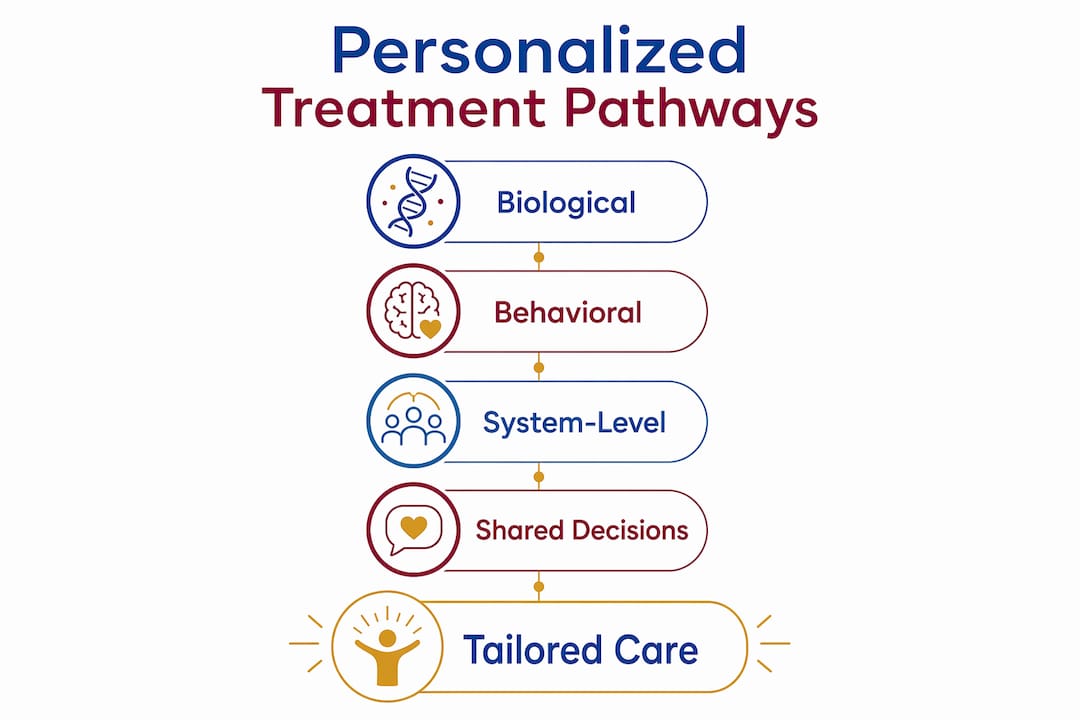
The clinical logic behind personalization runs through three distinct pathways: biological, behavioral, and system-level. Each one addresses a different reason why one-size-fits-all care fails.
Biological mechanisms
Biomarkers and pharmacogenomics allow clinicians to predict, with greater accuracy, which treatments are likely to work for a specific patient. Genetic variation affects how individuals metabolize medications, which means the standard dose of an antidepressant can be therapeutic for one person and ineffective or harmful for another. A broader review of individualized medicine confirms that pharmacogenomic guidance improves response rates and reduces adverse drug reactions in areas including depression and oncology. The National Human Genome Research Institute describes personalized medicine as using a patient’s genetic profile to select “the proper medication or therapy and administer it using the proper dose or regimen,” a framing that captures why precision diagnostics matter before any treatment decision is made.

Behavioral mechanisms
Biology alone is not enough. A 2025 paper in Communications Medicine argues that personalized medicine must integrate a patient’s lived experience alongside biological markers, warning against “de-personalized” precision medicine that reduces a person to their genome. When a plan accounts for a patient’s daily schedule, cultural background, personal values, and specific triggers, treatment acceptability rises. Patients who see their own life reflected in their care plan are more likely to engage, less likely to drop out, and more likely to sustain gains after treatment ends. For international clients and expatriates, this dimension is especially significant: cultural context and displacement stress are real clinical variables, not background noise.
System-level mechanisms
Shared decision-making converts patients from passive recipients into active partners. That shift matters for adherence and for the quality of the information clinicians receive. A 2025 systematic review found that participatory, personalized nursing interventions reduced adverse outcomes and readmissions across included studies. At the system level, a well-constructed plan also enables proactive monitoring: clinicians can detect early nonresponse signals and adjust before a patient deteriorates, rather than waiting for a crisis to prompt a change.

What the research actually shows
The evidence base for personalized care is growing, and the headline numbers are worth knowing.
Statistic callout: A 2023 meta-analysis of personalized psychological interventions reported an effect size of d = 0.22 and an NNT of approximately 8.5, meaning one additional successful outcome per about 8–9 patients treated with a personalized rather than standardized protocol.
That effect size is modest in isolation, but the NNT figure is clinically meaningful at scale. In a practice seeing dozens of patients, that difference translates to a measurable number of people who recover who otherwise would not have.
The real-world evidence is more striking in specific conditions. A primary care study in Type 2 diabetes found that implementing structured personalized care plans was associated with observed improvements in LDL cholesterol, systolic blood pressure, and BMI over follow-up. In maternal health, a 2025 systematic review reported adverse pregnancy outcomes were lower in a personalized-intervention group compared to the control group, alongside broader reductions in hospital readmissions.
Study / Source | Condition | Key Finding |
Meta-analysis, 2023 | Psychological interventions | Effect size d = 0.22; NNT ≈ 8.5 |
Systematic review, 2025 | Nursing / maternal health | Adverse outcomes were reduced compared to controls |
Real-world cohort study | Type 2 diabetes | Improved LDL, systolic BP, and BMI post care-plan |
Treatment personalization review | Depression (session dose) | 13–18 sessions for 50% achieving clinically significant change |
A note on limitations. The evidence is not uniformly strong across all conditions and settings. Studies vary considerably in how they define “personalization,” which populations they include, and how they measure outcomes. Heterogeneity across trials makes direct comparisons difficult, and calls for more standardized benchmarking trials are well-founded. The strongest evidence currently sits in chronic disease management, maternal health, and psychological therapy; evidence in rarer conditions and highly bespoke genetic therapies is still developing.
How clinicians actually build a personalized treatment plan
The process is sequential but iterative. A plan created at intake looks different six weeks later, and that evolution is by design.
Comprehensive assessment. The clinician gathers medical history, current symptoms, prior treatment responses, labs or biomarkers where relevant, and patient-reported outcome measures (PROMs). For mental health, this includes mapping specific triggers, sleep patterns, daily stressors, and life context, including cultural background and current environment.
Goal setting with the patient. Goals are defined in terms the patient cares about, not just clinical metrics. “Sleep through the night without waking” is more motivating than “improve sleep efficiency score.” Shared decision-making at this stage determines which treatment options are presented and how trade-offs are discussed.
Plan design: modality selection and sequencing. Clinicians select interventions based on the assessment data and sequence them deliberately. True personalized care differs from eclectic therapy: it uses data-driven methods to combine modalities purposefully. For example, sequencing EMDR for trauma processing before introducing CBT-based cognitive restructuring is a clinical decision, not a random mix. Integrative psychotherapy approaches follow this logic, combining RTT, EMDR, CBT, and hypnotherapy in a sequence matched to the individual.
Implementation. The plan is put into practice with agreed session frequency, homework or between-session tasks, and any lifestyle or medication components. Session frequency itself has a dose-response relationship: research on depression treatment suggests 13–18 sessions for approximately 50% of patients to achieve clinically significant change, though the right number varies by individual.
Routine outcome monitoring. Clinicians track progress using symptom scales, PROMs, and direct patient feedback at regular intervals. This is not a formality. Early nonresponse signals detected through routine monitoring allow clinicians to switch or augment interventions before a patient deteriorates.
Adjustment. The plan is treated as a living document. Dosage, modality, frequency, and sequencing are all candidates for revision as the patient evolves. A plan that made sense at week two may need meaningful changes by week eight.
A therapy plan for anxiety and burnout might include components such as: a trauma history screen, a sleep diary, identified cognitive distortions, EMDR targets, RTT session goals, and a weekly mood-tracking measure. A chronic disease plan might include: HbA1c targets, dietary goals, medication schedule, exercise benchmarks, and a monthly review date. The specific items differ; the structure and the iterative logic are the same.
Which patients gain the most from individualized care
Personalization matters most when the clinical picture is complex enough that a standard protocol is likely to miss something important.
Conditions and scenarios where tailored care tends to produce the clearest advantage:
Chronic disease with multiple risk factors (Type 2 diabetes, hypertension, cardiovascular disease): standard protocols address one variable at a time; personalized plans coordinate across all of them.
Comorbid mental health conditions (anxiety with depression, trauma with burnout): treatment sequencing and modality choice become critical when two or more conditions interact.
Treatment-resistant cases: patients who have not responded to one or more standard protocols are the clearest candidates for a data-driven, individualized approach.
Complex trauma and PTSD: trigger patterns, trauma history, and nervous system responses vary so significantly between individuals that a rigid protocol often fails or retraumatizes.
Rare or genetically influenced conditions: pharmacogenomic guidance is most valuable here, where standard dosing carries the highest risk of ineffectiveness or harm.
Expatriates and multicultural clients: cultural context and displacement are genuine clinical variables. A plan that ignores language, identity, and relocation stress is missing a significant part of the picture.
By contrast, a patient with a single, uncomplicated, first-episode condition and no relevant comorbidities may do well on a validated protocol without extensive personalization. The clinical question is always: does the complexity of this person’s situation exceed what a standard protocol was designed to handle?
Practical indicators that you should request a personalized plan:
You have tried a standard treatment and it did not work or caused significant side effects.
You have more than one diagnosis or a complex history.
Your symptoms have a clear personal trigger pattern that a generic protocol does not address.
Your daily life, work schedule, or cultural context makes standard recommendations difficult to follow.
What to expect: timelines, milestones, and monitoring
Progress in a personalized plan is not linear, but there are recognizable checkpoints.
Short term (weeks 1–6):
Initial assessment is completed and the plan is drafted with the patient.
Early symptom tracking begins; baseline measures are established.
First modality is introduced; patient and clinician assess fit and tolerability.
Any early nonresponse or side effects are flagged and addressed before they compound.
Medium term (weeks 6–12):
First formal review of progress against goals.
Adjustments to session frequency, modality, or sequencing based on outcome data.
For mental health: clinically significant change in symptom scores is a realistic target for a meaningful proportion of patients by week 12, though this varies by condition severity.
For chronic disease: measurable changes in biomarkers (LDL, BP, HbA1c) typically become visible in this window.
Longer term (months 6–12):
Consolidation of gains; focus shifts from symptom reduction to resilience and relapse prevention.
Plan may be stepped down in intensity or transitioned to maintenance.
Patient-reported quality-of-life measures become the primary success metric.
Common monitoring tools clinicians use include validated symptom scales (PHQ-9 for depression, GAD-7 for anxiety), PROMs, lab panels, adherence logs, and structured check-ins. The evidence-based review on treatment personalization specifically highlights routine outcome monitoring as the mechanism that enables timely plan adjustment, catching nonresponse early rather than waiting for deterioration.
Pro Tip: Ask your clinician at every review: “What would need to change in my results for you to adjust the plan?” That question keeps monitoring active rather than passive.
Costs, insurance coverage, and access options in the U.S.
Personalized care typically costs more upfront than a standard protocol, but the cost picture is more nuanced than it first appears.
Cost Component | Typical Range | Insurance Coverage Notes |
Initial comprehensive assessment | — | Often partially covered under mental health or primary care benefits; verify CPT codes with insurer |
Ongoing therapy sessions | — | Covered under mental health parity laws if provider is in-network; out-of-network varies widely |
Pharmacogenomic testing | — | Coverage inconsistent; some plans cover for treatment-resistant depression; preauthorization often required |
Remote monitoring tools / apps | $0–$50/month | Rarely covered; some employer wellness programs subsidize |
Specialty center consultations | Varies | Academic medical centers (Mayo Clinic, Cleveland Clinic) often bill through standard insurance |
Insurance realities. The Mental Health Parity and Addiction Equity Act requires that mental health benefits be no more restrictive than medical benefits, but “personalized” or “integrative” framing does not guarantee coverage. What matters to insurers is the CPT billing code, not the clinical philosophy. Preauthorization is commonly required for extended treatment courses, pharmacogenomic testing, and specialty referrals. Always verify benefits before starting, and ask specifically whether your plan covers out-of-network providers if your preferred clinician is not in-network.
Practical access routes:
Telehealth platforms have expanded access significantly; many licensed therapists and psychiatrists now offer personalized care remotely, which is particularly relevant for expatriates or those in underserved areas.
Federally Qualified Health Centers (FQHCs) offer sliding-scale fees based on income and are required to provide comprehensive primary care, including mental health services.
Employer EAPs (Employee Assistance Programs) often cover a limited number of sessions at no cost; some include care coordination services.
Research programs and academic medical centers sometimes offer personalized care at reduced cost in exchange for participation in outcome studies.
A Frontiers 2025 conceptual model on individualized therapies notes that regulatory oversight and transparency in bespoke care are evolving, which means patients should ask providers directly about the evidence base for any highly specialized intervention.
How you can actively participate in your own treatment plan
The quality of a personalized plan depends heavily on what you bring to it. Clinicians can only personalize what they know.
Questions to ask your clinician:
How will this plan be tailored specifically to my history and goals, rather than a standard protocol?
What assessment tools or biomarkers will you use to guide treatment decisions?
How will we measure progress, and how often will we review the plan?
What are the early signs that this approach is or is not working?
What are the alternatives if the first approach does not produce results?
How do you incorporate my personal goals and daily life into the plan?
Will you coordinate with other providers I am seeing?
What is the evidence base for the interventions you are recommending for my specific situation?
How much input do I have in choosing between treatment options?
What should I do between sessions to support the plan?
How will cultural or contextual factors in my life be accounted for?
At what point would you recommend changing the plan, and what would trigger that decision?
Information to prepare before your first visit:
A complete medication list, including supplements and dosages.
A summary of prior treatments and your honest assessment of what helped and what did not.
Your main goals for treatment, in your own words.
Known triggers, patterns, or situations that worsen your symptoms.
Relevant lifestyle factors: sleep schedule, work demands, exercise habits, diet.
Any family history relevant to your condition.
Practical barriers: schedule constraints, financial limits, transportation, language needs.
Red flags to watch for:
A clinician who prescribes or recommends a treatment after a single brief appointment with no follow-up plan.
No discussion of alternatives or trade-offs.
Resistance to shared decision-making or to your questions about the evidence.
No monitoring or review schedule built into the plan from the start.
Key Takeaways
Personalized treatment plans consistently outperform standardized protocols because they match intervention, dose, and sequencing to the individual’s biology, history, and goals, not just their diagnosis.
Point | Details |
Evidence supports personalization | A 2023 meta-analysis reported an NNT of approximately 8.5 for personalized psychological interventions vs. standardized protocols. |
Real-world outcomes are measurable | Personalized care plans in Type 2 diabetes improved LDL, blood pressure, and BMI; maternal health studies showed adverse outcomes of 7.59% vs. 20.00% in controls. |
Plans must be iterative | Treating the plan as a living document, with routine outcome monitoring and scheduled adjustments, is what separates effective personalization from a one-time assessment. |
Patient participation drives quality | The more specific and honest the information you bring to your clinician, the more precisely the plan can be tailored. |
Hesketherapy applies this approach | Hesketherapy builds individualized plans using RTT, EMDR, CBT, and hypnotherapy, sequenced to each client’s history, goals, and cultural context. |
Why personalization changes what therapy can do
Most people who come to therapy have already tried something that did not work. A generic anxiety protocol, a standard referral, advice to “try mindfulness.” The frustration is not a character flaw; it is often a signal that the intervention was not matched to the person.
What I have observed, working with clients across different cultural backgrounds and life circumstances, is that the turning point rarely comes from a new technique in isolation. It comes when the plan finally reflects the whole person: their specific trauma history, their daily pressures, the way their nervous system responds, and what they actually want their life to look like. That is when engagement shifts. Clients stop going through the motions and start doing the real work.
There is a tendency in discussions of personalized medicine to focus almost entirely on biomarkers and genetics. Those matter. But in mental health and psychotherapy, the “biography” side of the equation, the lived experience, the cultural context, the personal meaning a person attaches to their symptoms, is often where the most important clinical information lives. A plan that ignores that is not truly personalized, whatever the intake form says.
The research backs this up. The integration of biological and lived-experience factors in treatment planning is not a soft add-on; it is a clinical necessity. For expatriates and international clients especially, that lived experience includes displacement, identity negotiation, and the specific stressors of building a life in a new country. Accounting for those factors is not optional if the goal is lasting change.
If you are considering therapy and wondering whether a tailored approach is right for you, the personalized therapy overview at Hesketherapy is a good place to start.
Personalized therapy at Hesketherapy: what the first step looks like
At Hesketherapy, every client begins with a thorough assessment that maps their specific history, triggers, goals, and the practical realities of their daily life. From that foundation, a plan is built using an integrative combination of RTT, EMDR, CBT, counseling, and clinical hypnotherapy, sequenced deliberately rather than applied at random. The modality that comes first depends on what the assessment reveals: trauma processing before cognitive work, nervous system regulation before behavioral change.
The free discovery call lasts approximately 30 minutes. It covers your main concerns, what you have tried before, and whether Hesketherapy’s approach is the right fit for your situation. There is no pressure and no commitment required. If you are ready to find out what a plan built specifically around you could look like, you can book your discovery call and take that first step today.
Useful sources and further reading
In Brief: Personalized Medicine (NIH/NCBI Bookshelf) — A clear, accessible overview of what personalized medicine means in practice, how biomarkers guide treatment decisions, and what patients should understand about the evidence requirements for personalized approaches.
Personalized Medicine (National Human Genome Research Institute) — The NHGRI’s definition and framing of personalized medicine, with emphasis on genomics and the shift from population-level to individual-level treatment decisions.
Personalized Therapy Meta-Analysis, 2023 (White Rose eprints) — The primary source for the effect size (d = 0.22) and NNT (≈ 8.5) figures cited in this article; useful for readers who want to examine the statistical methodology directly.
Systematic Review on Personalized Nursing Interventions, 2025 (PMC) — Documents real-world outcome reductions in adverse events and readmissions; particularly relevant for chronic disease and maternal health contexts.
Implementation of a Personalized Care Plan for Type 2 Diabetes (PMC) — Real-world observational data on LDL, blood pressure, and BMI improvements following structured care-plan implementation in primary care.
Evidence-Based Strategies for Treatment Personalization: A Review (ScienceDirect) — Covers module sequencing, session frequency, dose-response findings, and routine outcome monitoring; the most practically useful source for clinicians and informed patients.
A Conceptual Model for Individualized Therapies (Frontiers in Medicine, 2025) — Addresses the ethical, regulatory, and delivery considerations for highly bespoke interventions; useful for understanding what questions to ask when a provider recommends a specialized or novel approach.
This article is general health information, not professional medical or psychological advice. For guidance specific to your situation, consult a qualified clinician or your primary care provider.
Recommended
Comments