Why Seek Multicultural Therapy: a Guide for Diverse Clients


TL;DR:
Multicultural therapy emphasizes integrating a client’s cultural background into mental health treatment to improve relevance and effectiveness. It focuses on systemic factors, social identities, and cultural values, leading to higher retention and better outcomes for diverse populations. Effectiveness depends on a therapist’s cultural humility, ongoing learning, and genuine engagement with clients’ unique experiences.
Multicultural therapy is a form of mental health treatment that deliberately incorporates a client’s cultural background, identity, and lived experiences into the therapeutic process to provide more relevant and effective care. Also called multicultural counseling, this approach treats race, ethnicity, immigration status, religion, gender identity, and socioeconomic context not as background details but as central factors shaping mental health. Research shows 81% of marginalized individuals report experiencing discrimination or microaggressions in standard therapeutic settings, and 44.2% of those clients leave therapy early. That dropout rate is not a client failure. It is a system failure that culturally competent mental health care is designed to fix.
Why seek multicultural therapy: the case for culturally responsive care
Culturally adapted therapy produces measurably better results than standard models for clients from diverse backgrounds. Clients in culturally adapted treatment attend more sessions and report greater satisfaction, largely because they spend less time educating their therapist and more time doing actual therapeutic work. That shift matters more than it sounds. Every session spent explaining your family’s cultural norms or your community’s relationship with mental health is a session not spent processing trauma, anxiety, or grief.

The multicultural counseling benefits extend beyond comfort. When a therapist understands that collectivist family structures, religious obligations, or experiences of systemic racism shape a client’s distress, the treatment plan becomes more accurate. Misdiagnosis and unhelpful interventions drop. Trust builds faster. The multicultural counseling framework that views multiple intersecting identities and social contexts as central to treatment planning reduces misunderstandings and strengthens the therapeutic alliance from the first session.
Multicultural therapy should be regarded as a foundational standard for all modern mental health care, not a specialty niche reserved for clients of color or immigrants. Any person whose identity has been shaped by culture, which is every person, benefits from a therapist who takes that seriously.
How therapists adapt their practice
Culturally competent therapists adjust their approach in concrete, observable ways:
They ask about family structure, community ties, and cultural values before assuming a Western individualist framework applies.
They recognize systemic oppression, including racism, homophobia, and xenophobia, as legitimate sources of psychological distress rather than cognitive distortions to be challenged.
They adapt communication styles, including directness, formality, and the use of metaphor, to match the client’s cultural norms.
They integrate spirituality and religious frameworks when the client identifies these as meaningful to their healing.
They use evidence-based modalities like CBT and EMDR while adjusting how those tools are applied to fit the client’s worldview.
Pro Tip: Ask a prospective therapist directly: “How do you incorporate cultural identity into your work?” A therapist who answers with specifics is practicing multicultural counseling. One who gives a vague answer about treating everyone equally may be practicing color-blind therapy, which research links to higher dropout rates.
What distinguishes multicultural therapy from standard talk therapy?
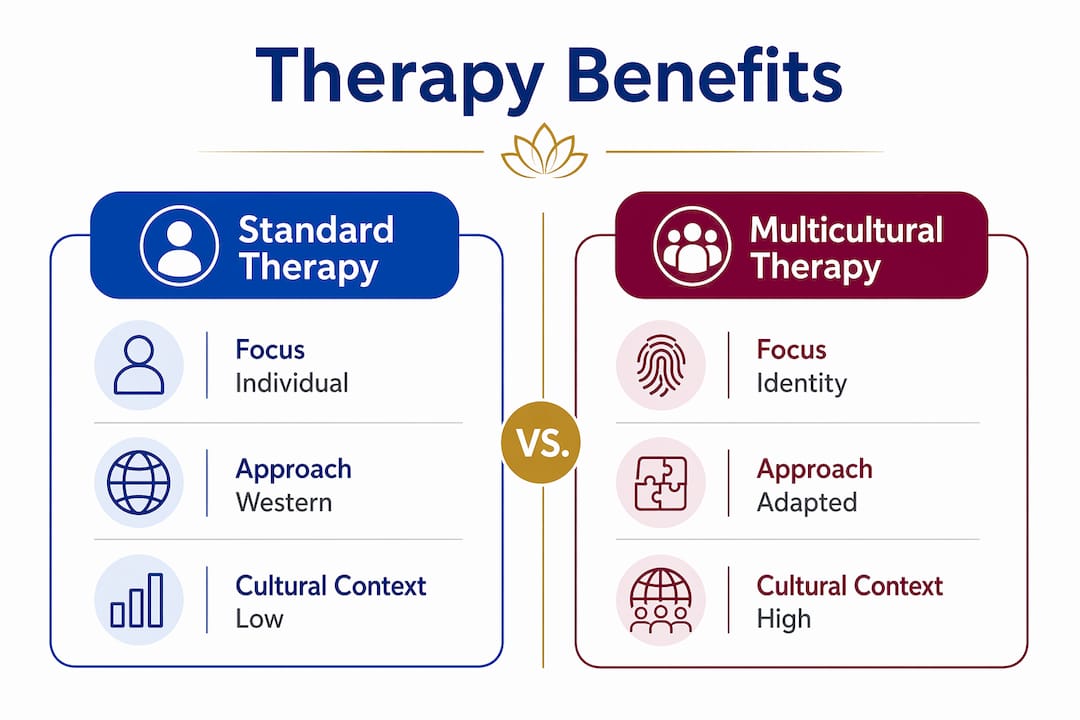
Standard talk therapy, even when delivered by a skilled clinician, typically operates from a Western, individualist framework. It focuses on the individual’s thoughts, behaviors, and relationships without systematically examining how cultural context, historical trauma, or systemic inequality shape those patterns. Multicultural therapy does not replace these methods. It reframes them.
The distinction becomes clearest when you compare how each approach handles the same presenting problem. A client experiencing anxiety after immigration may be told in standard therapy to challenge catastrophic thinking. A multicultural counselor recognizes that the anxiety may be a rational response to real legal precarity, cultural loss, and social isolation. The integration of cultural factors into conventional modalities like CBT and EMDR consistently outperforms one-size-fits-all treatments for diverse populations.
Feature | Standard therapy | Multicultural therapy |
Primary focus | Individual thoughts and behaviors | Individual within cultural and social context |
Systemic factors | Rarely addressed | Central to assessment and treatment |
Cultural values | May be overlooked | Actively integrated into treatment plan |
Spirituality | Optional or excluded | Included when client identifies it as relevant |
Therapist requirement | Clinical training | Clinical training plus cultural humility and ongoing education |
Outcome for diverse clients | Higher dropout, lower satisfaction | Higher retention, stronger therapeutic alliance |
A common misconception is that multicultural therapy requires a therapist who shares the client’s ethnic or cultural background. Shared identity can accelerate rapport, but it does not guarantee cultural competence. Clients benefit from culturally competent therapists even without shared background, provided the therapist demonstrates genuine cultural humility and ongoing engagement with diverse communities. What predicts effectiveness is the therapist’s openness, not their passport.
For a deeper look at how cultural sensitivity shapes therapy outcomes, Hesketherapy’s guide on cultural sensitivity in therapy offers a practical framework worth reading before your first session.
Who benefits most from seeking multicultural therapy?
The short answer is anyone whose identity has been shaped by experiences that standard therapy tends to overlook. The longer answer involves understanding intersectionality, the concept that overlapping identities, such as being a Black immigrant woman or a disabled queer person, create compounded experiences that no single-axis framework can address.
Groups that gain the most from culturally responsive care include:
BIPOC individuals navigating racial trauma, microaggressions, and the psychological weight of systemic racism.
LGBTQIA+ clients whose gender identity or sexual orientation intersects with cultural or religious backgrounds that may not affirm those identities.
Immigrants and expatriates managing acculturation stress, grief over cultural loss, and identity negotiation between two or more cultural worlds. Hesketherapy’s work with international clients addresses exactly this intersection.
Disabled individuals whose experiences of ableism are compounded by cultural attitudes toward disability within their communities.
First-generation professionals experiencing imposter syndrome rooted in class and cultural transitions.
Religious minorities whose spiritual frameworks are central to their mental health but are often dismissed or pathologized in secular clinical settings.
Healing through cultural therapy is particularly significant for trauma survivors. When trauma is rooted in discrimination, displacement, or cultural erasure, treatment that ignores those roots cannot fully resolve the wound. Adapted psychotherapy that includes clients’ spirituality and cultural values improves mental health outcomes, with a review of 97 studies finding that religiously and spiritually adapted therapy outperforms standard treatments. That is not a marginal finding. It means the content of a client’s belief system is clinically relevant, not just personally meaningful.
How to find and evaluate a culturally competent therapist
Finding a therapist who practices multicultural counseling effectively requires more than searching a directory for “diverse therapists.” The process involves active evaluation, and you are entitled to treat an initial consultation as an interview.
Ask about training directly. Request information about their multicultural counseling education, supervision, and any specialized training in working with your specific community. Vague answers signal limited preparation.
Assess their language around identity. A culturally competent therapist speaks about race, immigration, religion, and systemic oppression without discomfort or deflection. If they pivot quickly to individual coping strategies when you raise structural issues, that is a warning sign.
Look for community engagement. Therapists engaged in community involvement build stronger therapeutic relationships and achieve better long-term outcomes. Ask whether they attend cultural events, consult with community organizations, or engage in ongoing education outside the clinical setting.
Evaluate their response to mistakes. Cultural humility involves ongoing self-reflection about biases and readiness to repair trust when harm occurs. Ask how they handle it when a client feels misunderstood culturally. A good therapist welcomes that question.
Trust your gut after the first session. If you leave feeling like you spent the session educating your therapist rather than being helped, that is data. You should not be doing that labor.
Pro Tip: You do not need to find a therapist who shares your exact background. What you need is a therapist who has done the work to understand experiences different from their own. Ethnic minority therapists often show higher multicultural awareness due to lived experience and community engagement, but cultural humility in any therapist predicts effectiveness more reliably than demographic matching alone.
For clients living abroad, online therapy for expats offers culturally adapted care without geographic limitation, which matters when you are already navigating the stress of living outside your home culture.
Key takeaways
Multicultural therapy produces better outcomes for diverse clients because it treats cultural identity, systemic context, and intersecting social factors as clinically central rather than peripheral to mental health care.
Point | Details |
Cultural identity is clinically relevant | Ignoring cultural context leads to misdiagnosis, lower trust, and higher dropout rates. |
Adapted therapy outperforms standard models | Culturally adapted treatment increases session attendance and client satisfaction for diverse populations. |
Cultural humility beats demographic matching | A therapist’s openness and ongoing education predict effectiveness more than shared background. |
Intersectionality shapes treatment needs | Overlapping identities require treatment plans that account for compounded experiences, not single-axis frameworks. |
Clients should actively vet therapists | Use initial consultations to assess multicultural training, community engagement, and comfort with identity topics. |
What I have learned from working across cultures
Working with clients from Madrid to Amsterdam to Manila has taught me one consistent truth: the moment a client stops explaining themselves and starts being understood, something shifts. The session changes register. That shift is what multicultural therapy makes possible.
I have seen clients who spent years in therapy without meaningful progress arrive at Hesketherapy and make significant breakthroughs within weeks. Not because the previous therapists were incompetent, but because those therapists were working with an incomplete picture. They treated the symptom without understanding the soil it grew in.
The uncomfortable reality is that therapy without cultural responsiveness can actively harm clients. When a therapist frames a client’s collectivist family loyalty as enmeshment, or interprets religious coping as avoidance, they are not being neutral. They are applying a cultural lens while pretending they are not. That is more damaging than acknowledged ignorance, because the client often internalizes the misreading as truth.
What I advocate for is this: do not accept a therapeutic relationship where you feel like a guest explaining your world to a tourist. Your culture is not context. It is content. Any therapist worth your time already knows that. Advocate for it from the first conversation, and do not settle for less.
— Heske
Therapy that meets you where you are
If you are looking for mental health support that takes your full identity seriously, Hesketherapy offers culturally responsive care designed for international clients and expatriates navigating complex, multilingual lives. Working in English, Spanish, and Dutch, Hesketherapy integrates RTT, EMDR, CBT, and hypnotherapy into treatment plans shaped by each client’s background, values, and goals.
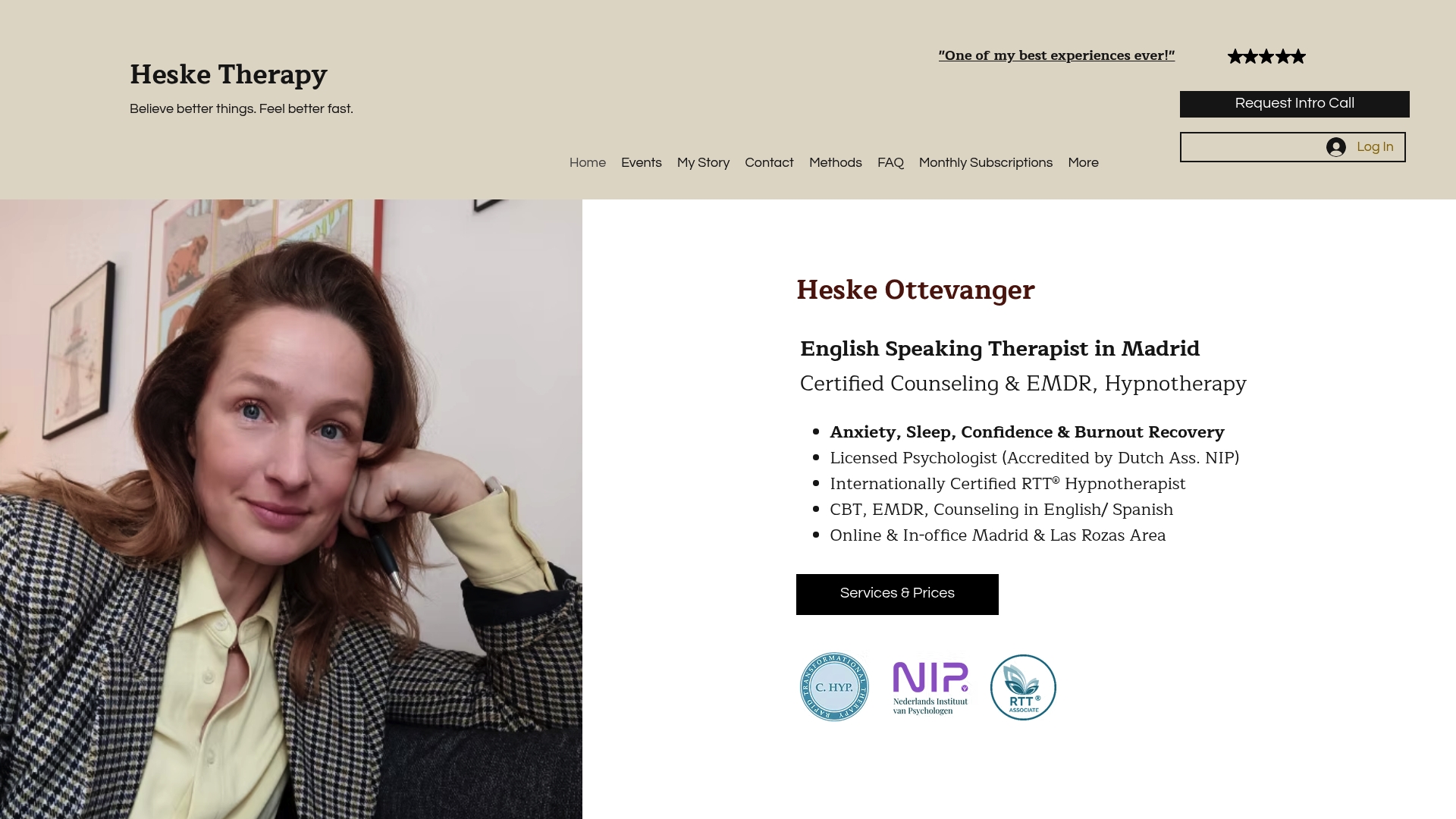
Whether you are managing anxiety, burnout, trauma, or the particular weight of living between cultures, Hesketherapy’s EMDR and hypnotherapy services are available both in-person in Madrid and online. You can also explore RTT therapy as a method for rapid, lasting change that adapts to who you are. Schedule a free discovery call to find out whether Hesketherapy is the right fit for you.
FAQ
What is multicultural therapy?
Multicultural therapy is a mental health framework that integrates a client’s cultural identity, lived experiences, and social context into the therapeutic process. It is not a standalone treatment but a lens applied within modalities like CBT and EMDR to improve relevance and effectiveness for diverse clients.
Why does cultural background matter in therapy?
Cultural background shapes how distress is experienced, expressed, and understood. Therapy that ignores cultural context risks misdiagnosis, cultural misattunement, and treatment dropout, with research showing 44.2% of clients experiencing microaggressions leave therapy prematurely.
Does my therapist need to share my cultural background?
No. Shared background can build rapport faster, but cultural humility and ongoing education predict therapeutic effectiveness more reliably than demographic matching. A therapist who actively engages with diverse communities and reflects on their own biases can provide strong culturally competent care.
Who benefits most from multicultural counseling?
BIPOC individuals, LGBTQIA+ clients, immigrants, expatriates, disabled people, and anyone whose identity involves navigating systemic oppression or cultural complexity gains the most from culturally responsive therapy. The benefits are especially significant for trauma survivors whose experiences are rooted in discrimination or displacement.
How do I know if a therapist is culturally competent?
Ask directly about their multicultural training, how they address systemic factors in treatment, and how they handle cultural misunderstandings with clients. A culturally competent therapist answers these questions with specifics and welcomes the conversation rather than deflecting toward generic claims of treating everyone equally.
Recommended
Comments